return to home page Computational Chemistry Comparison and Benchmark DataBase Release 22 (May 2022) Standard Reference Database 101 National Institute of Standards and Technology
You are here: Calculated > Energy > Optimized > Energy

All results from a given calculation for C3H4O2 (Methyl glyoxal)

using model chemistry: QCISD(T)/cc-pVTZ

19 10 17 12 22

States and conformations

State Conformation minimum conformation conformer description state description
1 1 yes CS 1A'
Energy calculated at QCISD(T)/cc-pVTZ
 hartrees
Energy at 0K-266.742161
Energy at 298.15K-266.746222
HF Energy-265.736988
Nuclear repulsion energy159.666653
The energy at 298.15K was derived from the energy at 0K and an integrated heat capacity that used the calculated vibrational frequencies.
Vibrational Frequencies calculated at QCISD(T)/cc-pVTZ
Mode Number Symmetry Frequency
(cm-1)
Scaled Frequency
(cm-1)
IR Intensities
(km mol-1)
Raman Act
(Å4/u)
Dep P Dep U
1 A' 3168 3005        
2 A' 3051 2894        
3 A' 2974 2821        
4 A' 1776 1684        
5 A' 1761 1671        
6 A' 1465 1390        
7 A' 1397 1325        
8 A' 1360 1290        
9 A' 1265 1200        
10 A' 1013 961        
11 A' 791 751        
12 A' 572 542        
13 A' 477 453        
14 A' 245 233        
15 A" 3121 2960        
16 A" 1472 1397        
17 A" 1073 1018        
18 A" 909 862        
19 A" 462 439        
20 A" 125 118        
21 A" 91 86        

Unscaled Zero Point Vibrational Energy (zpe) 14282.6 cm-1
Scaled (by 0.9486) Zero Point Vibrational Energy (zpe) 13548.5 cm-1
See section III.C.1 List or set vibrational scaling factors to change the scale factors used here.
See section III.C.2 Calculate a vibrational scaling factor for a given set of molecules to determine the least squares best scaling factor.
Rotational Constants (cm-1) from geometry optimized at QCISD(T)/cc-pVTZ
ABC
0.30331 0.14766 0.10116

See section I.F.4 to change rotational constant units
Geometric Data calculated at QCISD(T)/cc-pVTZ

Point Group is Cs

Cartesians (Å)
Atom x (Å) y (Å) z (Å)
C1 -0.844 -0.724 0.000
C2 0.000 0.553 0.000
C3 1.495 0.385 0.000
O4 -0.358 -1.834 0.000
O5 -0.585 1.620 0.000
H6 -1.932 -0.537 0.000
H7 1.973 1.361 0.000
H8 1.799 -0.192 0.876
H9 1.799 -0.192 -0.876

Atom - Atom Distances (Å)
  C1 C2 C3 O4 O5 H6 H7 H8 H9
C11.53082.58791.21132.35831.10423.50492.83462.8346
C21.53081.50402.41421.21642.21802.13232.13532.1353
C32.58791.50402.89112.41843.54811.08761.09201.0920
O41.21132.41422.89113.46142.03923.95592.84962.8496
O52.35831.21642.41843.46142.54262.57093.11973.1197
H61.10422.21803.54812.03922.54264.34183.84793.8479
H73.50492.13231.08763.95592.57094.34181.79171.7917
H82.83462.13531.09202.84963.11973.84791.79171.7516
H92.83462.13531.09202.84963.11973.84791.79171.7516

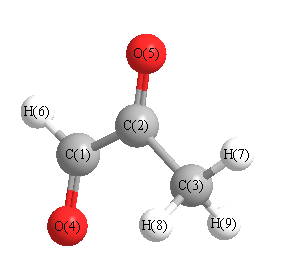
picture of Methyl glyoxal state 1 conformation 1
More geometry information
Calculated Bond Angles
atom1 atom2 atom3 angle atom1 atom2 atom3 angle
C1 C2 C3 117.015 C1 C2 O5 117.826
C2 C1 O4 122.954 C2 C1 H6 113.663
C2 C3 H7 109.681 C2 C3 H8 109.654
C2 C3 H9 109.654 C3 C2 O5 125.159
O4 C1 H6 123.383 H7 C3 H8 110.578
H7 C3 H9 110.578 H8 C3 H9 106.647
Electronic energy levels
Charges, Dipole, Quadrupole and Polarizability