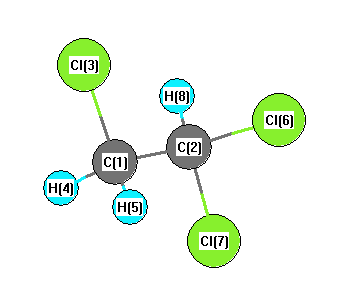
Vibrational Frequencies calculated at B1B95/cc-pVTZ
| Mode Number |
Symmetry |
Frequency
(cm-1) |
Scaled Frequency
(cm-1) |
IR Intensities
(km mol-1) |
Raman Act
(Å4/u) |
Dep P |
Dep U |
|---|
| 1 |
A |
3180 |
3043 |
0.37 |
|
|
|
| 2 |
A |
3158 |
3023 |
1.10 |
|
|
|
| 3 |
A |
3110 |
2977 |
5.71 |
|
|
|
| 4 |
A |
1462 |
1399 |
7.33 |
|
|
|
| 5 |
A |
1327 |
1271 |
6.17 |
|
|
|
| 6 |
A |
1278 |
1223 |
13.89 |
|
|
|
| 7 |
A |
1220 |
1167 |
16.41 |
|
|
|
| 8 |
A |
1173 |
1122 |
3.48 |
|
|
|
| 9 |
A |
1077 |
1031 |
4.45 |
|
|
|
| 10 |
A |
939 |
898 |
26.11 |
|
|
|
| 11 |
A |
788 |
754 |
14.34 |
|
|
|
| 12 |
A |
747 |
715 |
129.63 |
|
|
|
| 13 |
A |
678 |
649 |
30.11 |
|
|
|
| 14 |
A |
382 |
366 |
6.63 |
|
|
|
| 15 |
A |
331 |
317 |
1.17 |
|
|
|
| 16 |
A |
250 |
240 |
1.28 |
|
|
|
| 17 |
A |
172 |
165 |
3.99 |
|
|
|
| 18 |
A |
106 |
102 |
2.91 |
|
|
|
Unscaled Zero Point Vibrational Energy (zpe) 10688.3 cm
-1
Scaled (by 0.9571) Zero Point Vibrational Energy (zpe) 10229.7 cm
-1
See section
III.C.1 List or set vibrational scaling factors
to change the scale factors used here.
See section
III.C.2
Calculate a vibrational scaling factor for a given set of molecules
to determine the least squares best scaling factor.
Charges, Dipole, Quadrupole and Polarizability
Charges from optimized geometry at B1B95/cc-pVTZ
Charges (e)
| Number |
Element |
Mulliken |
CHELPG |
AIM |
ESP |
| 1 |
C |
-0.166 |
|
|
|
| 2 |
C |
-0.055 |
|
|
|
| 3 |
Cl |
-0.127 |
|
|
|
| 4 |
H |
0.171 |
|
|
|
| 5 |
H |
0.165 |
|
|
|
| 6 |
Cl |
-0.096 |
|
|
|
| 7 |
Cl |
-0.077 |
|
|
|
| 8 |
H |
0.186 |
|
|
|
Electric dipole moments
Electric dipole components in Debye
(What's a Debye? See section
VII.A.3)
| |
x |
y |
z |
Total |
| |
-0.092 |
-1.279 |
-0.138 |
1.289 |
| CHELPG |
|
|
|
|
| AIM |
|
|
|
|
| ESP |
|
|
|
|
Electric Quadrupole moment
Quadrupole components in D Å
| Primitive |
|---|
| | x | y | z |
|---|
| x |
-54.640 |
-0.095 |
0.420 |
| y |
-0.095 |
-49.520 |
-0.354 |
| z |
0.420 |
-0.354 |
-48.143 |
|
| Traceless |
|---|
| | x | y | z |
|---|
| x |
-5.809 |
-0.095 |
0.420 |
| y |
-0.095 |
1.871 |
-0.354 |
| z |
0.420 |
-0.354 |
3.937 |
|
| Polar |
|---|
| 3z2-r2 | 7.875 |
|---|
| x2-y2 | -5.120 |
|---|
| xy | -0.095 |
|---|
| xz | 0.420 |
|---|
| yz | -0.354 |
|---|
|
Polarizabilities
Components of the polarizability tensor.
Units are
Å
3 (Angstrom cubed)
Change units.
| |
x |
y |
z |
| x |
10.872 |
0.837 |
-0.294 |
| y |
0.837 |
8.965 |
-0.031 |
| z |
-0.294 |
-0.031 |
6.424 |
<r2> (average value of r
2) Å
2
| <r2> |
267.528 |
| (<r2>)1/2 |
16.356 |