Jump to
S2C1
Energy calculated at PBE1PBE/6-311G*
| | hartrees |
|---|
| Energy at 0K | -151.124858 |
| Energy at 298.15K | -151.123229 |
| HF Energy | -151.124858 |
| Nuclear repulsion energy | 46.031582 |
The energy at 298.15K was derived from the energy at 0K
and an integrated heat capacity that used the calculated vibrational frequencies.
Geometric Data calculated at PBE1PBE/6-311G*
Point Group is C∞v
Cartesians (Å)
| Atom |
x (Å) |
y (Å) |
z (Å) |
|---|
| C1 |
0.000 |
0.000 |
-1.415 |
| C2 |
0.000 |
0.000 |
-0.055 |
| O3 |
0.000 |
0.000 |
1.103 |
Atom - Atom Distances (Å)
| |
C1 |
C2 |
O3 |
| C1 | | 1.3595 | 2.5177 |
C2 | 1.3595 | | 1.1583 | O3 | 2.5177 | 1.1583 | |
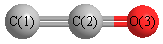 More geometry information
Calculated Bond Angles
| atom1 |
atom2 |
atom3 |
angle |
|
atom1 |
atom2 |
atom3 |
angle |
| C1 |
C2 |
O3 |
180.000 |
|
Electronic energy levels
Charges, Dipole, Quadrupole and Polarizability
Charges from optimized geometry at PBE1PBE/6-311G*
Charges (e)
| Number |
Element |
Mulliken |
CHELPG |
AIM |
ESP |
| 1 |
C |
-0.115 |
|
|
|
| 2 |
C |
0.265 |
|
|
|
| 3 |
O |
-0.151 |
|
|
|
Electric dipole moments
Electric dipole components in Debye
(What's a Debye? See section
VII.A.3)
| |
x |
y |
z |
Total |
| |
0.000 |
0.000 |
1.403 |
1.403 |
| CHELPG |
|
|
|
|
| AIM |
|
|
|
|
| ESP |
|
|
|
|
Electric Quadrupole moment
Quadrupole components in D Å
| Primitive |
|---|
| | x | y | z |
|---|
| x |
-15.695 |
0.000 |
0.000 |
| y |
0.000 |
-15.695 |
0.000 |
| z |
0.000 |
0.000 |
-22.284 |
|
| Traceless |
|---|
| | x | y | z |
|---|
| x |
3.295 |
0.000 |
0.000 |
| y |
0.000 |
3.295 |
0.000 |
| z |
0.000 |
0.000 |
-6.589 |
|
| Polar |
|---|
| 3z2-r2 | -13.178 |
|---|
| x2-y2 | 0.000 |
|---|
| xy | 0.000 |
|---|
| xz | 0.000 |
|---|
| yz | 0.000 |
|---|
|
Polarizabilities
Components of the polarizability tensor.
Units are
Å
3 (Angstrom cubed)
Change units.
| |
x |
y |
z |
| x |
2.204 |
0.000 |
0.000 |
| y |
0.000 |
2.204 |
0.000 |
| z |
0.000 |
0.000 |
5.235 |
<r2> (average value of r
2) Å
2
| <r2> |
32.935 |
| (<r2>)1/2 |
5.739 |
Jump to
S1C1
Energy calculated at PBE1PBE/6-311G*
| | hartrees |
|---|
| Energy at 0K | -151.079194 |
| Energy at 298.15K | -151.077596 |
| HF Energy | -151.079194 |
| Nuclear repulsion energy | 45.904526 |
The energy at 298.15K was derived from the energy at 0K
and an integrated heat capacity that used the calculated vibrational frequencies.
Geometric Data calculated at PBE1PBE/6-311G*
Point Group is C∞v
Cartesians (Å)
| Atom |
x (Å) |
y (Å) |
z (Å) |
|---|
| C1 |
0.000 |
0.000 |
-1.417 |
| C2 |
0.000 |
0.000 |
-0.058 |
| O3 |
0.000 |
0.000 |
1.106 |
Atom - Atom Distances (Å)
| |
C1 |
C2 |
O3 |
| C1 | | 1.3589 | 2.5231 |
C2 | 1.3589 | | 1.1642 | O3 | 2.5231 | 1.1642 | |
More geometry information
Calculated Bond Angles
| atom1 |
atom2 |
atom3 |
angle |
|
atom1 |
atom2 |
atom3 |
angle |
| C1 |
C2 |
O3 |
180.000 |
|
Electronic energy levels
Charges, Dipole, Quadrupole and Polarizability
Charges from optimized geometry at PBE1PBE/6-311G*
Charges (e)
| Number |
Element |
Mulliken |
CHELPG |
AIM |
ESP |
| 1 |
C |
-0.091 |
|
|
|
| 2 |
C |
0.248 |
|
|
|
| 3 |
O |
-0.157 |
|
|
|
Electric dipole moments
Electric dipole components in Debye
(What's a Debye? See section
VII.A.3)
| |
x |
y |
z |
Total |
| |
0.000 |
0.000 |
1.165 |
1.165 |
| CHELPG |
|
|
|
|
| AIM |
|
|
|
|
| ESP |
|
|
|
|
Electric Quadrupole moment
Quadrupole components in D Å
| Primitive |
|---|
| | x | y | z |
|---|
| x |
-14.072 |
0.000 |
0.000 |
| y |
0.000 |
-17.513 |
0.000 |
| z |
0.000 |
0.000 |
-22.014 |
|
| Traceless |
|---|
| | x | y | z |
|---|
| x |
5.692 |
0.000 |
0.000 |
| y |
0.000 |
0.530 |
0.000 |
| z |
0.000 |
0.000 |
-6.222 |
|
| Polar |
|---|
| 3z2-r2 | -12.443 |
|---|
| x2-y2 | 3.441 |
|---|
| xy | 0.000 |
|---|
| xz | 0.000 |
|---|
| yz | 0.000 |
|---|
|
Polarizabilities
Components of the polarizability tensor.
Units are
Å
3 (Angstrom cubed)
Change units.
| |
x |
y |
z |
| x |
2.095 |
0.000 |
0.000 |
| y |
0.000 |
1.821 |
0.000 |
| z |
0.000 |
0.000 |
5.131 |
<r2> (average value of r
2) Å
2
| <r2> |
33.014 |
| (<r2>)1/2 |
5.746 |
