Jump to
S1C2
Energy calculated at QCISD(T)/6-311G*
| | hartrees |
|---|
| Energy at 0K | -454.048217 |
| Energy at 298.15K | -454.052028 |
| HF Energy | -453.710859 |
| Nuclear repulsion energy | 57.387649 |
The energy at 298.15K was derived from the energy at 0K
and an integrated heat capacity that used the calculated vibrational frequencies.
Vibrational Frequencies calculated at QCISD(T)/6-311G*
| Mode Number |
Symmetry |
Frequency
(cm-1) |
Scaled Frequency
(cm-1) |
IR Intensities
(km mol-1) |
Raman Act
(Å4/u) |
Dep P |
Dep U |
|---|
| 1 |
A' |
3534 |
3402 |
|
|
|
|
| 2 |
A' |
2557 |
2462 |
|
|
|
|
| 3 |
A' |
1720 |
1656 |
|
|
|
|
| 4 |
A' |
1051 |
1012 |
|
|
|
|
| 5 |
A' |
934 |
900 |
|
|
|
|
| 6 |
A' |
669 |
644 |
|
|
|
|
| 7 |
A" |
3629 |
3494 |
|
|
|
|
| 8 |
A" |
1184 |
1140 |
|
|
|
|
| 9 |
A" |
475 |
457 |
|
|
|
|
Unscaled Zero Point Vibrational Energy (zpe) 7877.1 cm
-1
Scaled (by 0.9628) Zero Point Vibrational Energy (zpe) 7584.0 cm
-1
See section
III.C.1 List or set vibrational scaling factors
to change the scale factors used here.
See section
III.C.2
Calculate a vibrational scaling factor for a given set of molecules
to determine the least squares best scaling factor.
Geometric Data calculated at QCISD(T)/6-311G*
Point Group is Cs
Cartesians (Å)
| Atom |
x (Å) |
y (Å) |
z (Å) |
|---|
| N1 |
0.015 |
1.114 |
0.000 |
| S2 |
0.015 |
-0.621 |
0.000 |
| H3 |
-1.329 |
-0.783 |
0.000 |
| H4 |
0.489 |
1.460 |
0.825 |
| H5 |
0.489 |
1.460 |
-0.825 |
Atom - Atom Distances (Å)
| |
N1 |
S2 |
H3 |
H4 |
H5 |
| N1 | | 1.7354 | 2.3256 | 1.0125 | 1.0125 |
S2 | 1.7354 | | 1.3541 | 2.2883 | 2.2883 | H3 | 2.3256 | 1.3541 | | 3.0033 | 3.0033 | H4 | 1.0125 | 2.2883 | 3.0033 | | 1.6504 | H5 | 1.0125 | 2.2883 | 3.0033 | 1.6504 | |
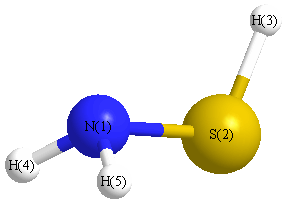 More geometry information
Calculated Bond Angles
| atom1 |
atom2 |
atom3 |
angle |
|
atom1 |
atom2 |
atom3 |
angle |
| N1 |
S2 |
H3 |
96.883 |
|
S2 |
N1 |
H4 |
109.953 |
| S2 |
N1 |
H5 |
109.953 |
|
H4 |
N1 |
H5 |
109.172 |
Electronic energy levels
Charges, Dipole, Quadrupole and Polarizability
Jump to
S1C1
Energy calculated at QCISD(T)/6-311G*
| | hartrees |
|---|
| Energy at 0K | -454.046863 |
| Energy at 298.15K | -454.050716 |
| HF Energy | -453.710183 |
| Nuclear repulsion energy | 57.683267 |
The energy at 298.15K was derived from the energy at 0K
and an integrated heat capacity that used the calculated vibrational frequencies.
Vibrational Frequencies calculated at QCISD(T)/6-311G*
| Mode Number |
Symmetry |
Frequency
(cm-1) |
Scaled Frequency
(cm-1) |
IR Intensities
(km mol-1) |
Raman Act
(Å4/u) |
Dep P |
Dep U |
|---|
| 1 |
A' |
3540 |
3408 |
|
|
|
|
| 2 |
A' |
2452 |
2361 |
|
|
|
|
| 3 |
A' |
1704 |
1641 |
|
|
|
|
| 4 |
A' |
1040 |
1001 |
|
|
|
|
| 5 |
A' |
892 |
859 |
|
|
|
|
| 6 |
A' |
650 |
626 |
|
|
|
|
| 7 |
A" |
3644 |
3508 |
|
|
|
|
| 8 |
A" |
1169 |
1126 |
|
|
|
|
| 9 |
A" |
565 |
544 |
|
|
|
|
Unscaled Zero Point Vibrational Energy (zpe) 7827.9 cm
-1
Scaled (by 0.9628) Zero Point Vibrational Energy (zpe) 7536.7 cm
-1
See section
III.C.1 List or set vibrational scaling factors
to change the scale factors used here.
See section
III.C.2
Calculate a vibrational scaling factor for a given set of molecules
to determine the least squares best scaling factor.
Geometric Data calculated at QCISD(T)/6-311G*
Point Group is Cs
Electronic energy levels
Charges, Dipole, Quadrupole and Polarizability
