Jump to
S1C2
S1C3
Energy calculated at HF/6-311G*
| | hartrees |
|---|
| Energy at 0K | -254.191781 |
| Energy at 298.15K | -254.191201 |
| HF Energy | -254.191781 |
| Nuclear repulsion energy | 46.720863 |
The energy at 298.15K was derived from the energy at 0K
and an integrated heat capacity that used the calculated vibrational frequencies.
Geometric Data calculated at HF/6-311G*
Point Group is C∞v
Cartesians (Å)
| Atom |
x (Å) |
y (Å) |
z (Å) |
|---|
| C1 |
0.000 |
0.000 |
-0.709 |
| N2 |
0.000 |
0.000 |
-1.852 |
| Na3 |
0.000 |
0.000 |
1.565 |
Atom - Atom Distances (Å)
| |
C1 |
N2 |
Na3 |
| C1 | | 1.1433 | 2.2742 |
N2 | 1.1433 | | 3.4175 | Na3 | 2.2742 | 3.4175 | |
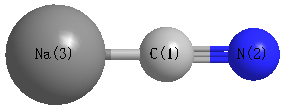 More geometry information
Calculated Bond Angles
| atom1 |
atom2 |
atom3 |
angle |
|
atom1 |
atom2 |
atom3 |
angle |
| C1 |
N2 |
Na3 |
0.000 |
|
C1 |
Na3 |
N2 |
0.000 |
| N2 |
C1 |
Na3 |
180.000 |
|
Electronic energy levels
Charges, Dipole, Quadrupole and Polarizability
Charges from optimized geometry at HF/6-311G*
Charges (e)
| Number |
Element |
Mulliken |
CHELPG |
AIM |
ESP |
| 1 |
C |
-0.351 |
|
|
|
| 2 |
N |
-0.398 |
|
|
|
| 3 |
Na |
0.750 |
|
|
|
Electric dipole moments
Electric dipole components in Debye
(What's a Debye? See section
VII.A.3)
| |
x |
y |
z |
Total |
| |
0.000 |
0.000 |
11.276 |
11.276 |
| CHELPG |
|
|
|
|
| AIM |
|
|
|
|
| ESP |
|
|
|
|
Electric Quadrupole moment
Quadrupole components in D Å
| Primitive |
|---|
| | x | y | z |
|---|
| x |
-16.880 |
0.000 |
0.000 |
| y |
0.000 |
-16.880 |
0.000 |
| z |
0.000 |
0.000 |
-13.330 |
|
| Traceless |
|---|
| | x | y | z |
|---|
| x |
-1.775 |
0.000 |
0.000 |
| y |
0.000 |
-1.775 |
0.000 |
| z |
0.000 |
0.000 |
3.550 |
|
| Polar |
|---|
| 3z2-r2 | 7.101 |
|---|
| x2-y2 | 0.000 |
|---|
| xy | 0.000 |
|---|
| xz | 0.000 |
|---|
| yz | 0.000 |
|---|
|
Polarizabilities
Components of the polarizability tensor.
Units are
Å
3 (Angstrom cubed)
Change units.
| |
x |
y |
z |
| x |
2.173 |
0.000 |
0.000 |
| y |
0.000 |
2.173 |
0.000 |
| z |
0.000 |
0.000 |
4.297 |
<r2> (average value of r
2) Å
2
| <r2> |
63.784 |
| (<r2>)1/2 |
7.987 |
Jump to
S1C1
S1C3
Energy calculated at HF/6-311G*
| | hartrees |
|---|
| Energy at 0K | -254.199027 |
| Energy at 298.15K | -254.198717 |
| HF Energy | -254.199027 |
| Nuclear repulsion energy | 51.582782 |
The energy at 298.15K was derived from the energy at 0K
and an integrated heat capacity that used the calculated vibrational frequencies.
Geometric Data calculated at HF/6-311G*
Point Group is Cs
Cartesians (Å)
| Atom |
x (Å) |
y (Å) |
z (Å) |
|---|
| C1 |
1.127 |
0.773 |
0.000 |
| N2 |
0.000 |
1.027 |
0.000 |
| Na3 |
-0.615 |
-1.075 |
0.000 |
Atom - Atom Distances (Å)
| |
C1 |
N2 |
Na3 |
| C1 | | 1.1559 | 2.5396 |
N2 | 1.1559 | | 2.1904 | Na3 | 2.5396 | 2.1904 | |
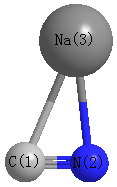 More geometry information
Calculated Bond Angles
| atom1 |
atom2 |
atom3 |
angle |
|
atom1 |
atom2 |
atom3 |
angle |
| C1 |
N2 |
Na3 |
93.574 |
|
C1 |
Na3 |
N2 |
27.017 |
| N2 |
C1 |
Na3 |
59.410 |
|
Electronic energy levels
Charges, Dipole, Quadrupole and Polarizability
Charges from optimized geometry at HF/6-311G*
Charges (e)
| Number |
Element |
Mulliken |
CHELPG |
AIM |
ESP |
| 1 |
C |
-0.158 |
|
|
|
| 2 |
N |
-0.533 |
|
|
|
| 3 |
Na |
0.691 |
|
|
|
Electric dipole moments
Electric dipole components in Debye
(What's a Debye? See section
VII.A.3)
| |
x |
y |
z |
Total |
| |
-4.744 |
-8.029 |
0.000 |
9.325 |
| CHELPG |
|
|
|
|
| AIM |
|
|
|
|
| ESP |
|
|
|
|
Electric Quadrupole moment
Quadrupole components in D Å
| Primitive |
|---|
| | x | y | z |
|---|
| x |
-19.748 |
2.873 |
0.000 |
| y |
2.873 |
-13.663 |
0.000 |
| z |
0.000 |
0.000 |
-16.969 |
|
| Traceless |
|---|
| | x | y | z |
|---|
| x |
-4.432 |
2.873 |
0.000 |
| y |
2.873 |
4.696 |
0.000 |
| z |
0.000 |
0.000 |
-0.263 |
|
| Polar |
|---|
| 3z2-r2 | -0.527 |
|---|
| x2-y2 | -6.085 |
|---|
| xy | 2.873 |
|---|
| xz | 0.000 |
|---|
| yz | 0.000 |
|---|
|
Polarizabilities
Components of the polarizability tensor.
Units are
Å
3 (Angstrom cubed)
Change units.
| |
x |
y |
z |
| x |
3.578 |
-0.039 |
0.000 |
| y |
-0.039 |
2.749 |
0.000 |
| z |
0.000 |
0.000 |
2.322 |
<r2> (average value of r
2) Å
2
| <r2> |
45.957 |
| (<r2>)1/2 |
6.779 |
Jump to
S1C1
S1C2
Energy calculated at HF/6-311G*
| | hartrees |
|---|
| Energy at 0K | -254.197940 |
| Energy at 298.15K | -254.197140 |
| HF Energy | -254.197940 |
| Nuclear repulsion energy | 49.117483 |
The energy at 298.15K was derived from the energy at 0K
and an integrated heat capacity that used the calculated vibrational frequencies.
Geometric Data calculated at HF/6-311G*
Point Group is C∞v
Cartesians (Å)
| Atom |
x (Å) |
y (Å) |
z (Å) |
|---|
| C1 |
0.000 |
0.000 |
-1.838 |
| N2 |
0.000 |
0.000 |
-0.683 |
| Na3 |
0.000 |
0.000 |
1.437 |
Atom - Atom Distances (Å)
| |
C1 |
N2 |
Na3 |
| C1 | | 1.1558 | 3.2753 |
N2 | 1.1558 | | 2.1196 | Na3 | 3.2753 | 2.1196 | |
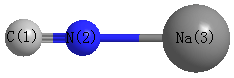 More geometry information
Calculated Bond Angles
| atom1 |
atom2 |
atom3 |
angle |
|
atom1 |
atom2 |
atom3 |
angle |
| C1 |
N2 |
Na3 |
180.000 |
|
C1 |
Na3 |
N2 |
0.000 |
| N2 |
C1 |
Na3 |
0.000 |
|
Electronic energy levels
Charges, Dipole, Quadrupole and Polarizability
Charges from optimized geometry at HF/6-311G*
Charges (e)
| Number |
Element |
Mulliken |
CHELPG |
AIM |
ESP |
| 1 |
C |
-0.149 |
|
|
|
| 2 |
N |
-0.643 |
|
|
|
| 3 |
Na |
0.793 |
|
|
|
Electric dipole moments
Electric dipole components in Debye
(What's a Debye? See section
VII.A.3)
| |
x |
y |
z |
Total |
| |
0.000 |
0.000 |
10.934 |
10.934 |
| CHELPG |
|
|
|
|
| AIM |
|
|
|
|
| ESP |
|
|
|
|
Electric Quadrupole moment
Quadrupole components in D Å
| Primitive |
|---|
| | x | y | z |
|---|
| x |
-16.758 |
0.000 |
0.000 |
| y |
0.000 |
-16.758 |
0.000 |
| z |
0.000 |
0.000 |
-15.403 |
|
| Traceless |
|---|
| | x | y | z |
|---|
| x |
-0.677 |
0.000 |
0.000 |
| y |
0.000 |
-0.677 |
0.000 |
| z |
0.000 |
0.000 |
1.354 |
|
| Polar |
|---|
| 3z2-r2 | 2.709 |
|---|
| x2-y2 | 0.000 |
|---|
| xy | 0.000 |
|---|
| xz | 0.000 |
|---|
| yz | 0.000 |
|---|
|
Polarizabilities
Components of the polarizability tensor.
Units are
Å
3 (Angstrom cubed)
Change units.
| |
x |
y |
z |
| x |
2.110 |
0.000 |
0.000 |
| y |
0.000 |
2.110 |
0.000 |
| z |
0.000 |
0.000 |
4.127 |
<r2> (average value of r
2) Å
2
| <r2> |
56.437 |
| (<r2>)1/2 |
7.512 |
