Jump to
S1C2
S1C3
Energy calculated at B2PLYP/6-311G*
| | hartrees |
|---|
| Energy at 0K | -100.303092 |
| Energy at 298.15K | -100.302139 |
| HF Energy | -100.199958 |
| Nuclear repulsion energy | 27.582128 |
The energy at 298.15K was derived from the energy at 0K
and an integrated heat capacity that used the calculated vibrational frequencies.
Geometric Data calculated at B2PLYP/6-311G*
Point Group is C∞v
Cartesians (Å)
| Atom |
x (Å) |
y (Å) |
z (Å) |
|---|
| Li1 |
0.000 |
0.000 |
-2.062 |
| C2 |
0.000 |
0.000 |
-0.155 |
| N3 |
0.000 |
0.000 |
1.016 |
Atom - Atom Distances (Å)
| |
Li1 |
C2 |
N3 |
| Li1 | | 1.9079 | 3.0789 |
C2 | 1.9079 | | 1.1710 | N3 | 3.0789 | 1.1710 | |
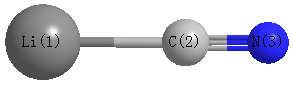 More geometry information
Calculated Bond Angles
| atom1 |
atom2 |
atom3 |
angle |
|
atom1 |
atom2 |
atom3 |
angle |
| Li1 |
C2 |
N3 |
180.000 |
|
Li1 |
N3 |
C2 |
0.000 |
| C2 |
Li1 |
N3 |
0.000 |
|
Electronic energy levels
Charges, Dipole, Quadrupole and Polarizability
Charges from optimized geometry at B2PLYP/6-311G*
Charges (e)
| Number |
Element |
Mulliken |
CHELPG |
AIM |
ESP |
| 1 |
Li |
0.579 |
|
|
|
| 2 |
C |
-0.291 |
|
|
|
| 3 |
N |
-0.288 |
|
|
|
Electric dipole moments
Electric dipole components in Debye
(What's a Debye? See section
VII.A.3)
| |
x |
y |
z |
Total |
| |
0.000 |
0.000 |
-8.888 |
8.888 |
| CHELPG |
|
|
|
|
| AIM |
|
|
|
|
| ESP |
|
|
|
|
Electric Quadrupole moment
Quadrupole components in D Å
| Primitive |
|---|
| | x | y | z |
|---|
| x |
-14.294 |
0.000 |
0.000 |
| y |
0.000 |
-14.294 |
0.000 |
| z |
0.000 |
0.000 |
1.028 |
|
| Traceless |
|---|
| | x | y | z |
|---|
| x |
-7.661 |
0.000 |
0.000 |
| y |
0.000 |
-7.661 |
0.000 |
| z |
0.000 |
0.000 |
15.322 |
|
| Polar |
|---|
| 3z2-r2 | 30.644 |
|---|
| x2-y2 | 0.000 |
|---|
| xy | 0.000 |
|---|
| xz | 0.000 |
|---|
| yz | 0.000 |
|---|
|
Polarizabilities
Components of the polarizability tensor.
Units are
Å
3 (Angstrom cubed)
Change units.
| |
x |
y |
z |
| x |
2.323 |
0.000 |
0.000 |
| y |
0.000 |
2.323 |
0.000 |
| z |
0.000 |
0.000 |
4.226 |
<r2> (average value of r
2) Å
2
| <r2> |
25.874 |
| (<r2>)1/2 |
5.087 |
Jump to
S1C1
S1C3
Energy calculated at B2PLYP/6-311G*
| | hartrees |
|---|
| Energy at 0K | -100.307398 |
| Energy at 298.15K | -100.306662 |
| HF Energy | -100.205454 |
| Nuclear repulsion energy | 29.279549 |
The energy at 298.15K was derived from the energy at 0K
and an integrated heat capacity that used the calculated vibrational frequencies.
Geometric Data calculated at B2PLYP/6-311G*
Point Group is Cs
Cartesians (Å)
| Atom |
x (Å) |
y (Å) |
z (Å) |
|---|
| Li1 |
1.434 |
-0.581 |
0.000 |
| C2 |
-0.717 |
-0.372 |
0.000 |
| N3 |
0.000 |
0.568 |
0.000 |
Atom - Atom Distances (Å)
| |
Li1 |
C2 |
N3 |
| Li1 | | 2.1614 | 1.8378 |
C2 | 2.1614 | | 1.1818 | N3 | 1.8378 | 1.1818 | |
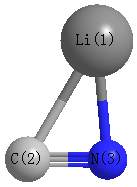 More geometry information
Calculated Bond Angles
| atom1 |
atom2 |
atom3 |
angle |
|
atom1 |
atom2 |
atom3 |
angle |
| Li1 |
C2 |
N3 |
58.214 |
|
Li1 |
N3 |
C2 |
88.651 |
| C2 |
Li1 |
N3 |
33.135 |
|
Electronic energy levels
Charges, Dipole, Quadrupole and Polarizability
Charges from optimized geometry at B2PLYP/6-311G*
Charges (e)
| Number |
Element |
Mulliken |
CHELPG |
AIM |
ESP |
| 1 |
Li |
0.474 |
|
|
|
| 2 |
C |
-0.118 |
|
|
|
| 3 |
N |
-0.356 |
|
|
|
Electric dipole moments
Electric dipole components in Debye
(What's a Debye? See section
VII.A.3)
| |
x |
y |
z |
Total |
| |
6.419 |
-2.431 |
0.000 |
6.864 |
| CHELPG |
|
|
|
|
| AIM |
|
|
|
|
| ESP |
|
|
|
|
Electric Quadrupole moment
Quadrupole components in D Å
| Primitive |
|---|
| | x | y | z |
|---|
| x |
-6.312 |
-5.937 |
0.000 |
| y |
-5.937 |
-15.226 |
0.000 |
| z |
0.000 |
0.000 |
-14.528 |
|
| Traceless |
|---|
| | x | y | z |
|---|
| x |
8.565 |
-5.937 |
0.000 |
| y |
-5.937 |
-4.806 |
0.000 |
| z |
0.000 |
0.000 |
-3.760 |
|
| Polar |
|---|
| 3z2-r2 | -7.519 |
|---|
| x2-y2 | 8.914 |
|---|
| xy | -5.937 |
|---|
| xz | 0.000 |
|---|
| yz | 0.000 |
|---|
|
Polarizabilities
Components of the polarizability tensor.
Units are
Å
3 (Angstrom cubed)
Change units.
| |
x |
y |
z |
| x |
3.367 |
0.335 |
0.000 |
| y |
0.335 |
3.293 |
0.000 |
| z |
0.000 |
0.000 |
2.609 |
<r2> (average value of r
2) Å
2
| <r2> |
20.767 |
| (<r2>)1/2 |
4.557 |
Jump to
S1C1
S1C2
Energy calculated at B2PLYP/6-311G*
| | hartrees |
|---|
| Energy at 0K | -100.307033 |
| Energy at 298.15K | -100.305903 |
| HF Energy | -100.207829 |
| Nuclear repulsion energy | 28.332354 |
The energy at 298.15K was derived from the energy at 0K
and an integrated heat capacity that used the calculated vibrational frequencies.
Geometric Data calculated at B2PLYP/6-311G*
Point Group is C∞v
Cartesians (Å)
| Atom |
x (Å) |
y (Å) |
z (Å) |
|---|
| Li1 |
0.000 |
0.000 |
1.879 |
| C2 |
0.000 |
0.000 |
-1.070 |
| N3 |
0.000 |
0.000 |
0.112 |
Atom - Atom Distances (Å)
| |
Li1 |
C2 |
N3 |
| Li1 | | 2.9482 | 1.7667 |
C2 | 2.9482 | | 1.1815 | N3 | 1.7667 | 1.1815 | |
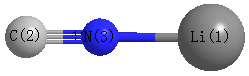 More geometry information
Calculated Bond Angles
| atom1 |
atom2 |
atom3 |
angle |
|
atom1 |
atom2 |
atom3 |
angle |
| Li1 |
C2 |
N3 |
0.000 |
|
Li1 |
N3 |
C2 |
180.000 |
| C2 |
Li1 |
N3 |
0.000 |
|
Electronic energy levels
Charges, Dipole, Quadrupole and Polarizability
Charges from optimized geometry at B2PLYP/6-311G*
Charges (e)
| Number |
Element |
Mulliken |
CHELPG |
AIM |
ESP |
| 1 |
Li |
0.582 |
|
|
|
| 2 |
C |
-0.145 |
|
|
|
| 3 |
N |
-0.437 |
|
|
|
Electric dipole moments
Electric dipole components in Debye
(What's a Debye? See section
VII.A.3)
| |
x |
y |
z |
Total |
| |
0.000 |
0.000 |
8.792 |
8.792 |
| CHELPG |
|
|
|
|
| AIM |
|
|
|
|
| ESP |
|
|
|
|
Electric Quadrupole moment
Quadrupole components in D Å
| Primitive |
|---|
| | x | y | z |
|---|
| x |
-14.283 |
0.000 |
0.000 |
| y |
0.000 |
-14.283 |
0.000 |
| z |
0.000 |
0.000 |
-2.571 |
|
| Traceless |
|---|
| | x | y | z |
|---|
| x |
-5.856 |
0.000 |
0.000 |
| y |
0.000 |
-5.856 |
0.000 |
| z |
0.000 |
0.000 |
11.712 |
|
| Polar |
|---|
| 3z2-r2 | 23.424 |
|---|
| x2-y2 | 0.000 |
|---|
| xy | 0.000 |
|---|
| xz | 0.000 |
|---|
| yz | 0.000 |
|---|
|
Polarizabilities
Components of the polarizability tensor.
Units are
Å
3 (Angstrom cubed)
Change units.
| |
x |
y |
z |
| x |
2.349 |
0.000 |
0.000 |
| y |
0.000 |
2.349 |
0.000 |
| z |
0.000 |
0.000 |
4.448 |
<r2> (average value of r
2) Å
2
| <r2> |
24.022 |
| (<r2>)1/2 |
4.901 |
