Jump to
S1C2
Energy calculated at ROHF/6-311G*
| | hartrees |
|---|
| Energy at 0K | -188.173049 |
| Energy at 298.15K | -188.174235 |
| HF Energy | -188.173049 |
| Nuclear repulsion energy | 64.402335 |
The energy at 298.15K was derived from the energy at 0K
and an integrated heat capacity that used the calculated vibrational frequencies.
Vibrational Frequencies calculated at ROHF/6-311G*
| Mode Number |
Symmetry |
Frequency
(cm-1) |
Scaled Frequency
(cm-1) |
IR Intensities
(km mol-1) |
Raman Act
(Å4/u) |
Dep P |
Dep U |
|---|
| 1 |
A' |
4034 |
3452 |
71.42 |
|
|
|
| 2 |
A' |
2090 |
1788 |
529.44 |
|
|
|
| 3 |
A' |
1425 |
1220 |
2.38 |
|
|
|
| 4 |
A' |
1245 |
1065 |
258.45 |
|
|
|
| 5 |
A' |
674 |
577 |
57.99 |
|
|
|
| 6 |
A" |
652 |
558 |
191.50 |
|
|
|
Unscaled Zero Point Vibrational Energy (zpe) 5060.1 cm
-1
Scaled (by 0.8556) Zero Point Vibrational Energy (zpe) 4329.4 cm
-1
See section
III.C.1 List or set vibrational scaling factors
to change the scale factors used here.
See section
III.C.2
Calculate a vibrational scaling factor for a given set of molecules
to determine the least squares best scaling factor.
Geometric Data calculated at ROHF/6-311G*
Point Group is Cs
Cartesians (Å)
| Atom |
x (Å) |
y (Å) |
z (Å) |
|---|
| C1 |
0.000 |
0.433 |
0.000 |
| O2 |
-1.038 |
-0.360 |
0.000 |
| O3 |
1.134 |
0.194 |
0.000 |
| H4 |
-0.763 |
-1.268 |
0.000 |
Atom - Atom Distances (Å)
| |
C1 |
O2 |
O3 |
H4 |
| C1 | | 1.3067 | 1.1586 | 1.8646 |
O2 | 1.3067 | | 2.2416 | 0.9489 | O3 | 1.1586 | 2.2416 | | 2.3949 | H4 | 1.8646 | 0.9489 | 2.3949 | |
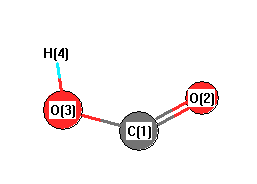 More geometry information
Calculated Bond Angles
| atom1 |
atom2 |
atom3 |
angle |
|
atom1 |
atom2 |
atom3 |
angle |
| C1 |
O2 |
H4 |
110.510 |
|
O2 |
C1 |
O3 |
130.712 |
Electronic energy levels
Charges, Dipole, Quadrupole and Polarizability
Charges from optimized geometry at ROHF/6-311G*
Charges (e)
| Number |
Element |
Mulliken |
CHELPG |
AIM |
ESP |
| 1 |
C |
0.490 |
|
|
|
| 2 |
O |
-0.554 |
|
|
|
| 3 |
O |
-0.376 |
|
|
|
| 4 |
H |
0.440 |
|
|
|
Electric dipole moments
Electric dipole components in Debye
(What's a Debye? See section
VII.A.3)
| |
x |
y |
z |
Total |
| |
-1.238 |
-1.594 |
0.000 |
2.019 |
| CHELPG |
|
|
|
|
| AIM |
|
|
|
|
| ESP |
|
|
|
|
Electric Quadrupole moment
Quadrupole components in D Å
| Primitive |
|---|
| | x | y | z |
|---|
| x |
-21.143 |
0.542 |
-0.002 |
| y |
0.542 |
-13.185 |
-0.003 |
| z |
-0.002 |
-0.003 |
-15.870 |
|
| Traceless |
|---|
| | x | y | z |
|---|
| x |
-6.616 |
0.542 |
-0.002 |
| y |
0.542 |
5.322 |
-0.003 |
| z |
-0.002 |
-0.003 |
1.294 |
|
| Polar |
|---|
| 3z2-r2 | 2.589 |
|---|
| x2-y2 | -7.959 |
|---|
| xy | 0.542 |
|---|
| xz | -0.002 |
|---|
| yz | -0.003 |
|---|
|
Polarizabilities
Components of the polarizability tensor.
Units are
Å
3 (Angstrom cubed)
Change units.
| |
x |
y |
z |
| x |
0.000 |
0.000 |
0.000 |
| y |
0.000 |
0.000 |
0.000 |
| z |
0.000 |
0.000 |
0.000 |
<r2> (average value of r
2) Å
2
| <r2> |
34.013 |
| (<r2>)1/2 |
5.832 |
Jump to
S1C1
Energy calculated at ROHF/6-311G*
| | hartrees |
|---|
| Energy at 0K | -188.172419 |
| Energy at 298.15K | -188.173555 |
| HF Energy | -188.172419 |
| Nuclear repulsion energy | 64.164817 |
The energy at 298.15K was derived from the energy at 0K
and an integrated heat capacity that used the calculated vibrational frequencies.
Vibrational Frequencies calculated at ROHF/6-311G*
| Mode Number |
Symmetry |
Frequency
(cm-1) |
Scaled Frequency
(cm-1) |
IR Intensities
(km mol-1) |
Raman Act
(Å4/u) |
Dep P |
Dep U |
|---|
| 1 |
A' |
4162 |
3561 |
132.21 |
|
|
|
| 2 |
A' |
2142 |
1833 |
418.27 |
|
|
|
| 3 |
A' |
1404 |
1201 |
391.74 |
|
|
|
| 4 |
A' |
1211 |
1036 |
35.88 |
|
|
|
| 5 |
A' |
697 |
596 |
8.23 |
|
|
|
| 6 |
A" |
555 |
474 |
115.86 |
|
|
|
Unscaled Zero Point Vibrational Energy (zpe) 5084.8 cm
-1
Scaled (by 0.8556) Zero Point Vibrational Energy (zpe) 4350.6 cm
-1
See section
III.C.1 List or set vibrational scaling factors
to change the scale factors used here.
See section
III.C.2
Calculate a vibrational scaling factor for a given set of molecules
to determine the least squares best scaling factor.
Geometric Data calculated at ROHF/6-311G*
Point Group is Cs
Cartesians (Å)
| Atom |
x (Å) |
y (Å) |
z (Å) |
|---|
| C1 |
0.000 |
0.390 |
0.000 |
| O2 |
-0.924 |
-0.547 |
0.000 |
| O3 |
1.147 |
0.276 |
0.000 |
| H4 |
-1.786 |
-0.171 |
0.000 |
Atom - Atom Distances (Å)
| |
C1 |
O2 |
O3 |
H4 |
| C1 | | 1.3156 | 1.1525 | 1.8721 |
O2 | 1.3156 | | 2.2284 | 0.9415 | O3 | 1.1525 | 2.2284 | | 2.9672 | H4 | 1.8721 | 0.9415 | 2.9672 | |
More geometry information
Calculated Bond Angles
| atom1 |
atom2 |
atom3 |
angle |
|
atom1 |
atom2 |
atom3 |
angle |
| C1 |
O2 |
H4 |
110.998 |
|
O2 |
C1 |
O3 |
128.960 |
Electronic energy levels
Charges, Dipole, Quadrupole and Polarizability
Charges from optimized geometry at ROHF/6-311G*
Charges (e)
| Number |
Element |
Mulliken |
CHELPG |
AIM |
ESP |
| 1 |
C |
0.435 |
|
|
|
| 2 |
O |
-0.538 |
|
|
|
| 3 |
O |
-0.350 |
|
|
|
| 4 |
H |
0.454 |
|
|
|
Electric dipole moments
Electric dipole components in Debye
(What's a Debye? See section
VII.A.3)
| |
x |
y |
z |
Total |
| |
-3.541 |
0.753 |
0.000 |
3.620 |
| CHELPG |
|
|
|
|
| AIM |
|
|
|
|
| ESP |
|
|
|
|
Electric Quadrupole moment
Quadrupole components in D Å
| Primitive |
|---|
| | x | y | z |
|---|
| x |
-14.091 |
-1.352 |
-0.004 |
| y |
-1.352 |
-17.791 |
-0.000 |
| z |
-0.004 |
-0.000 |
-15.905 |
|
| Traceless |
|---|
| | x | y | z |
|---|
| x |
2.757 |
-1.352 |
-0.004 |
| y |
-1.352 |
-2.793 |
-0.000 |
| z |
-0.004 |
-0.000 |
0.036 |
|
| Polar |
|---|
| 3z2-r2 | 0.071 |
|---|
| x2-y2 | 3.700 |
|---|
| xy | -1.352 |
|---|
| xz | -0.004 |
|---|
| yz | -0.000 |
|---|
|
Polarizabilities
Components of the polarizability tensor.
Units are
Å
3 (Angstrom cubed)
Change units.
| |
x |
y |
z |
| x |
0.000 |
0.000 |
0.000 |
| y |
0.000 |
0.000 |
0.000 |
| z |
0.000 |
0.000 |
0.000 |
<r2> (average value of r
2) Å
2
| <r2> |
34.435 |
| (<r2>)1/2 |
5.868 |
