Jump to
S1C2
S2C1
S2C2
Energy calculated at HF/6-311G*
| | hartrees |
|---|
| Energy at 0K | -130.707865 |
| Energy at 298.15K | -130.707267 |
| HF Energy | -130.707865 |
| Nuclear repulsion energy | 47.372278 |
The energy at 298.15K was derived from the energy at 0K
and an integrated heat capacity that used the calculated vibrational frequencies.
Vibrational Frequencies calculated at HF/6-311G*
| Mode Number |
Symmetry |
Frequency
(cm-1) |
Scaled Frequency
(cm-1) |
IR Intensities
(km mol-1) |
Raman Act
(Å4/u) |
Dep P |
Dep U |
|---|
| 1 |
A' |
3485 |
3152 |
13.70 |
|
|
|
| 2 |
A' |
1662 |
1503 |
128.99 |
|
|
|
| 3 |
A' |
1201 |
1086 |
4.25 |
|
|
|
| 4 |
A' |
647 |
585 |
21.45 |
|
|
|
| 5 |
A' |
392 |
354 |
0.59 |
|
|
|
| 6 |
A" |
421 |
381 |
0.21 |
|
|
|
Unscaled Zero Point Vibrational Energy (zpe) 3903.7 cm
-1
Scaled (by 0.9044) Zero Point Vibrational Energy (zpe) 3530.5 cm
-1
See section
III.C.1 List or set vibrational scaling factors
to change the scale factors used here.
See section
III.C.2
Calculate a vibrational scaling factor for a given set of molecules
to determine the least squares best scaling factor.
Geometric Data calculated at HF/6-311G*
Point Group is Cs
Cartesians (Å)
| Atom |
x (Å) |
y (Å) |
z (Å) |
|---|
| C1 |
0.200 |
-1.215 |
0.000 |
| C2 |
0.000 |
0.092 |
0.000 |
| N3 |
-0.308 |
1.243 |
0.000 |
| H4 |
0.954 |
-1.965 |
0.000 |
Atom - Atom Distances (Å)
| |
C1 |
C2 |
N3 |
H4 |
| C1 | | 1.3220 | 2.5101 | 1.0639 |
C2 | 1.3220 | | 1.1918 | 2.2676 | N3 | 2.5101 | 1.1918 | | 3.4477 | H4 | 1.0639 | 2.2676 | 3.4477 | |
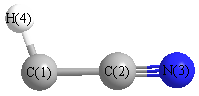 More geometry information
Calculated Bond Angles
| atom1 |
atom2 |
atom3 |
angle |
|
atom1 |
atom2 |
atom3 |
angle |
| C1 |
C2 |
N3 |
173.739 |
|
C2 |
C1 |
H4 |
143.553 |
Electronic energy levels
Charges, Dipole, Quadrupole and Polarizability
Jump to
S1C1
S2C1
S2C2
Energy calculated at HF/6-311G*
| | hartrees |
|---|
| Energy at 0K | -130.705479 |
| Energy at 298.15K | |
| HF Energy | -130.705479 |
| Nuclear repulsion energy | 47.466838 |
The energy at 298.15K was derived from the energy at 0K
and an integrated heat capacity that used the calculated vibrational frequencies.
Vibrational Frequencies calculated at HF/6-311G*
| Mode Number |
Symmetry |
Frequency
(cm-1) |
Scaled Frequency
(cm-1) |
IR Intensities
(km mol-1) |
Raman Act
(Å4/u) |
Dep P |
Dep U |
|---|
| 1 |
Σ |
3560 |
3219 |
48.90 |
|
|
|
| 2 |
Σ |
1578 |
1427 |
116.94 |
|
|
|
| 3 |
Σ |
1251 |
1132 |
0.00 |
|
|
|
| 4 |
Π |
421 |
381 |
0.04 |
|
|
|
| 4 |
Π |
421 |
381 |
0.04 |
|
|
|
| 5 |
Π |
433i |
391i |
45.96 |
|
|
|
| 5 |
Π |
433i |
391i |
45.96 |
|
|
|
Unscaled Zero Point Vibrational Energy (zpe) 3182.3 cm
-1
Scaled (by 0.9044) Zero Point Vibrational Energy (zpe) 2878.1 cm
-1
See section
III.C.1 List or set vibrational scaling factors
to change the scale factors used here.
See section
III.C.2
Calculate a vibrational scaling factor for a given set of molecules
to determine the least squares best scaling factor.
Geometric Data calculated at HF/6-311G*
Point Group is C∞v
Cartesians (Å)
| Atom |
x (Å) |
y (Å) |
z (Å) |
|---|
| C1 |
0.000 |
0.000 |
-1.207 |
| C2 |
0.000 |
0.000 |
0.080 |
| N3 |
0.000 |
0.000 |
1.290 |
| H4 |
0.000 |
0.000 |
-2.265 |
Atom - Atom Distances (Å)
| |
C1 |
C2 |
N3 |
H4 |
| C1 | | 1.2867 | 2.4971 | 1.0574 |
C2 | 1.2867 | | 1.2104 | 2.3441 | N3 | 2.4971 | 1.2104 | | 3.5545 | H4 | 1.0574 | 2.3441 | 3.5545 | |
More geometry information
Calculated Bond Angles
| atom1 |
atom2 |
atom3 |
angle |
|
atom1 |
atom2 |
atom3 |
angle |
| C1 |
C2 |
N3 |
180.000 |
|
C2 |
C1 |
H4 |
180.000 |
Electronic energy levels
Charges, Dipole, Quadrupole and Polarizability
Charges from optimized geometry at HF/6-311G*
Charges (e)
| Number |
Element |
Mulliken |
CHELPG |
AIM |
ESP |
| 1 |
C |
-0.061 |
|
|
|
| 2 |
C |
0.035 |
|
|
|
| 3 |
N |
-0.284 |
|
|
|
| 4 |
H |
0.311 |
|
|
|
Electric dipole moments
Electric dipole components in Debye
(What's a Debye? See section
VII.A.3)
| |
x |
y |
z |
Total |
| |
0.000 |
0.000 |
-3.194 |
3.194 |
| CHELPG |
|
|
|
|
| AIM |
|
|
|
|
| ESP |
|
|
|
|
Electric Quadrupole moment
Quadrupole components in D Å
| Primitive |
|---|
| | x | y | z |
|---|
| x |
-17.391 |
0.000 |
0.000 |
| y |
0.000 |
-17.391 |
0.000 |
| z |
0.000 |
0.000 |
-15.616 |
|
| Traceless |
|---|
| | x | y | z |
|---|
| x |
-0.887 |
0.000 |
0.000 |
| y |
0.000 |
-0.887 |
0.000 |
| z |
0.000 |
0.000 |
1.775 |
|
| Polar |
|---|
| 3z2-r2 | 3.550 |
|---|
| x2-y2 | 0.000 |
|---|
| xy | 0.000 |
|---|
| xz | 0.000 |
|---|
| yz | 0.000 |
|---|
|
Polarizabilities
Components of the polarizability tensor.
Units are
Å
3 (Angstrom cubed)
Change units.
| |
x |
y |
z |
| x |
1.872 |
0.000 |
0.000 |
| y |
0.000 |
1.872 |
0.000 |
| z |
0.000 |
0.000 |
5.690 |
<r2> (average value of r
2) Å
2
| <r2> |
36.050 |
| (<r2>)1/2 |
6.004 |
Jump to
S1C1
S1C2
S2C2
Energy calculated at HF/6-311G*
| | hartrees |
|---|
| Energy at 0K | -130.648209 |
| Energy at 298.15K | -130.647754 |
| HF Energy | -130.648209 |
| Nuclear repulsion energy | 47.429984 |
The energy at 298.15K was derived from the energy at 0K
and an integrated heat capacity that used the calculated vibrational frequencies.
Vibrational Frequencies calculated at HF/6-311G*
| Mode Number |
Symmetry |
Frequency
(cm-1) |
Scaled Frequency
(cm-1) |
IR Intensities
(km mol-1) |
Raman Act
(Å4/u) |
Dep P |
Dep U |
|---|
| 1 |
A' |
3253 |
2942 |
11.85 |
|
|
|
| 2 |
A' |
2355 |
2129 |
36.03 |
|
|
|
| 3 |
A' |
1145 |
1035 |
70.18 |
|
|
|
| 4 |
A' |
1019 |
922 |
21.25 |
|
|
|
| 5 |
A' |
485 |
438 |
28.19 |
|
|
|
| 6 |
A" |
363 |
328 |
15.46 |
|
|
|
Unscaled Zero Point Vibrational Energy (zpe) 4309.3 cm
-1
Scaled (by 0.9044) Zero Point Vibrational Energy (zpe) 3897.4 cm
-1
See section
III.C.1 List or set vibrational scaling factors
to change the scale factors used here.
See section
III.C.2
Calculate a vibrational scaling factor for a given set of molecules
to determine the least squares best scaling factor.
Geometric Data calculated at HF/6-311G*
Point Group is Cs
Cartesians (Å)
| Atom |
x (Å) |
y (Å) |
z (Å) |
|---|
| C1 |
-0.241 |
-1.272 |
0.000 |
| C2 |
0.000 |
0.113 |
0.000 |
| N3 |
0.105 |
1.250 |
0.000 |
| H4 |
0.714 |
-1.792 |
0.000 |
Atom - Atom Distances (Å)
| |
C1 |
C2 |
N3 |
H4 |
| C1 | | 1.4052 | 2.5449 | 1.0877 |
C2 | 1.4052 | | 1.1418 | 2.0340 | N3 | 2.5449 | 1.1418 | | 3.1019 | H4 | 1.0877 | 2.0340 | 3.1019 | |
More geometry information
Electronic energy levels
Charges, Dipole, Quadrupole and Polarizability
Charges from optimized geometry at HF/6-311G*
Charges (e)
| Number |
Element |
Mulliken |
CHELPG |
AIM |
ESP |
| 1 |
C |
-0.073 |
|
|
|
| 2 |
C |
0.111 |
|
|
|
| 3 |
N |
-0.290 |
|
|
|
| 4 |
H |
0.252 |
|
|
|
Electric dipole moments
Electric dipole components in Debye
(What's a Debye? See section
VII.A.3)
| |
x |
y |
z |
Total |
| |
1.494 |
-2.092 |
0.000 |
2.571 |
| CHELPG |
|
|
|
|
| AIM |
|
|
|
|
| ESP |
|
|
|
|
Electric Quadrupole moment
Quadrupole components in D Å
| Primitive |
|---|
| | x | y | z |
|---|
| x |
-18.511 |
-3.527 |
0.000 |
| y |
-3.527 |
-20.420 |
0.000 |
| z |
0.000 |
0.000 |
-15.992 |
|
| Traceless |
|---|
| | x | y | z |
|---|
| x |
-0.305 |
-3.527 |
0.000 |
| y |
-3.527 |
-3.169 |
0.000 |
| z |
0.000 |
0.000 |
3.474 |
|
| Polar |
|---|
| 3z2-r2 | 6.948 |
|---|
| x2-y2 | 1.910 |
|---|
| xy | -3.527 |
|---|
| xz | 0.000 |
|---|
| yz | 0.000 |
|---|
|
Polarizabilities
Components of the polarizability tensor.
Units are
Å
3 (Angstrom cubed)
Change units.
| |
x |
y |
z |
| x |
2.345 |
0.177 |
0.000 |
| y |
0.177 |
5.688 |
0.000 |
| z |
0.000 |
0.000 |
2.437 |
<r2> (average value of r
2) Å
2
| <r2> |
36.291 |
| (<r2>)1/2 |
6.024 |
Jump to
S1C1
S1C2
S2C1
Energy calculated at HF/6-311G*
| | hartrees |
|---|
| Energy at 0K | -130.648209 |
| Energy at 298.15K | -130.647754 |
| HF Energy | -130.648209 |
| Nuclear repulsion energy | 47.429984 |
The energy at 298.15K was derived from the energy at 0K
and an integrated heat capacity that used the calculated vibrational frequencies.
Vibrational Frequencies calculated at HF/6-311G*
Geometric Data calculated at HF/6-311G*
Point Group is Cs
Electronic energy levels
Charges, Dipole, Quadrupole and Polarizability
