Jump to
S1C2
S2C1
S2C2
Energy calculated at B3LYPultrafine/6-311G*
| | hartrees |
|---|
| Energy at 0K | -131.454747 |
| Energy at 298.15K | -131.454023 |
| HF Energy | -131.454747 |
| Nuclear repulsion energy | 47.480747 |
The energy at 298.15K was derived from the energy at 0K
and an integrated heat capacity that used the calculated vibrational frequencies.
Vibrational Frequencies calculated at B3LYPultrafine/6-311G*
| Mode Number |
Symmetry |
Frequency
(cm-1) |
Scaled Frequency
(cm-1) |
IR Intensities
(km mol-1) |
Raman Act
(Å4/u) |
Dep P |
Dep U |
|---|
| 1 |
A' |
3383 |
3269 |
34.37 |
|
|
|
| 2 |
A' |
1778 |
1718 |
31.30 |
|
|
|
| 3 |
A' |
1241 |
1199 |
6.40 |
|
|
|
| 4 |
A' |
465 |
449 |
11.13 |
|
|
|
| 5 |
A' |
352 |
340 |
44.33 |
|
|
|
| 6 |
A" |
456 |
441 |
1.31 |
|
|
|
Unscaled Zero Point Vibrational Energy (zpe) 3837.5 cm
-1
Scaled (by 0.9663) Zero Point Vibrational Energy (zpe) 3708.2 cm
-1
See section
III.C.1 List or set vibrational scaling factors
to change the scale factors used here.
See section
III.C.2
Calculate a vibrational scaling factor for a given set of molecules
to determine the least squares best scaling factor.
Geometric Data calculated at B3LYPultrafine/6-311G*
Point Group is Cs
Cartesians (Å)
| Atom |
x (Å) |
y (Å) |
z (Å) |
|---|
| C1 |
0.069 |
-1.214 |
0.000 |
| C2 |
0.000 |
0.085 |
0.000 |
| N3 |
-0.141 |
1.276 |
0.000 |
| H4 |
0.576 |
-2.154 |
0.000 |
Atom - Atom Distances (Å)
| |
C1 |
C2 |
N3 |
H4 |
| C1 | | 1.3003 | 2.4982 | 1.0689 |
C2 | 1.3003 | | 1.1993 | 2.3121 | N3 | 2.4982 | 1.1993 | | 3.5043 | H4 | 1.0689 | 2.3121 | 3.5043 | |
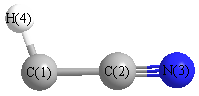 More geometry information
Calculated Bond Angles
| atom1 |
atom2 |
atom3 |
angle |
|
atom1 |
atom2 |
atom3 |
angle |
| C1 |
C2 |
N3 |
176.266 |
|
C2 |
C1 |
H4 |
154.661 |
Electronic energy levels
Charges, Dipole, Quadrupole and Polarizability
Jump to
S1C1
S2C1
S2C2
Energy calculated at B3LYPultrafine/6-311G*
| | hartrees |
|---|
| Energy at 0K | -131.454382 |
| Energy at 298.15K | |
| HF Energy | -131.454382 |
| Nuclear repulsion energy | 47.531481 |
The energy at 298.15K was derived from the energy at 0K
and an integrated heat capacity that used the calculated vibrational frequencies.
Vibrational Frequencies calculated at B3LYPultrafine/6-311G*
| Mode Number |
Symmetry |
Frequency
(cm-1) |
Scaled Frequency
(cm-1) |
IR Intensities
(km mol-1) |
Raman Act
(Å4/u) |
Dep P |
Dep U |
|---|
| 1 |
Σ |
3437 |
3321 |
58.75 |
|
|
|
| 2 |
Σ |
1731 |
1673 |
32.45 |
|
|
|
| 3 |
Σ |
1274 |
1231 |
4.56 |
|
|
|
| 4 |
Π |
457 |
442 |
0.55 |
|
|
|
| 4 |
Π |
457 |
442 |
0.55 |
|
|
|
| 5 |
Π |
244i |
235i |
53.25 |
|
|
|
| 5 |
Π |
244i |
235i |
53.25 |
|
|
|
Unscaled Zero Point Vibrational Energy (zpe) 3434.4 cm
-1
Scaled (by 0.9663) Zero Point Vibrational Energy (zpe) 3318.6 cm
-1
See section
III.C.1 List or set vibrational scaling factors
to change the scale factors used here.
See section
III.C.2
Calculate a vibrational scaling factor for a given set of molecules
to determine the least squares best scaling factor.
Geometric Data calculated at B3LYPultrafine/6-311G*
Point Group is C∞v
Cartesians (Å)
| Atom |
x (Å) |
y (Å) |
z (Å) |
|---|
| C1 |
0.000 |
0.000 |
-1.205 |
| C2 |
0.000 |
0.000 |
0.081 |
| N3 |
0.000 |
0.000 |
1.287 |
| H4 |
0.000 |
0.000 |
-2.269 |
Atom - Atom Distances (Å)
| |
C1 |
C2 |
N3 |
H4 |
| C1 | | 1.2856 | 2.4922 | 1.0647 |
C2 | 1.2856 | | 1.2066 | 2.3503 | N3 | 2.4922 | 1.2066 | | 3.5569 | H4 | 1.0647 | 2.3503 | 3.5569 | |
More geometry information
Calculated Bond Angles
| atom1 |
atom2 |
atom3 |
angle |
|
atom1 |
atom2 |
atom3 |
angle |
| C1 |
C2 |
N3 |
180.000 |
|
C2 |
C1 |
H4 |
180.000 |
Electronic energy levels
Charges, Dipole, Quadrupole and Polarizability
Charges from optimized geometry at B3LYPultrafine/6-311G*
Charges (e)
| Number |
Element |
Mulliken |
CHELPG |
AIM |
ESP |
| 1 |
C |
-0.076 |
|
|
|
| 2 |
C |
0.005 |
|
|
|
| 3 |
N |
-0.212 |
|
|
|
| 4 |
H |
0.283 |
|
|
|
Electric dipole moments
Electric dipole components in Debye
(What's a Debye? See section
VII.A.3)
| |
x |
y |
z |
Total |
| |
0.000 |
0.000 |
-3.251 |
3.251 |
| CHELPG |
|
|
|
|
| AIM |
|
|
|
|
| ESP |
|
|
|
|
Electric Quadrupole moment
Quadrupole components in D Å
| Primitive |
|---|
| | x | y | z |
|---|
| x |
-17.272 |
0.000 |
0.000 |
| y |
0.000 |
-17.272 |
0.000 |
| z |
0.000 |
0.000 |
-15.481 |
|
| Traceless |
|---|
| | x | y | z |
|---|
| x |
-0.896 |
0.000 |
0.000 |
| y |
0.000 |
-0.896 |
0.000 |
| z |
0.000 |
0.000 |
1.791 |
|
| Polar |
|---|
| 3z2-r2 | 3.583 |
|---|
| x2-y2 | 0.000 |
|---|
| xy | 0.000 |
|---|
| xz | 0.000 |
|---|
| yz | 0.000 |
|---|
|
Polarizabilities
Components of the polarizability tensor.
Units are
Å
3 (Angstrom cubed)
Change units.
| |
x |
y |
z |
| x |
1.903 |
0.000 |
0.000 |
| y |
0.000 |
1.903 |
0.000 |
| z |
0.000 |
0.000 |
6.341 |
<r2> (average value of r
2) Å
2
| <r2> |
35.915 |
| (<r2>)1/2 |
5.993 |
Jump to
S1C1
S1C2
S2C2
Energy calculated at B3LYPultrafine/6-311G*
| | hartrees |
|---|
| Energy at 0K | -131.429998 |
| Energy at 298.15K | -131.429462 |
| HF Energy | -131.429998 |
| Nuclear repulsion energy | 47.124995 |
The energy at 298.15K was derived from the energy at 0K
and an integrated heat capacity that used the calculated vibrational frequencies.
Vibrational Frequencies calculated at B3LYPultrafine/6-311G*
| Mode Number |
Symmetry |
Frequency
(cm-1) |
Scaled Frequency
(cm-1) |
IR Intensities
(km mol-1) |
Raman Act
(Å4/u) |
Dep P |
Dep U |
|---|
| 1 |
A' |
3071 |
2967 |
11.00 |
|
|
|
| 2 |
A' |
2095 |
2025 |
20.08 |
|
|
|
| 3 |
A' |
1090 |
1053 |
40.69 |
|
|
|
| 4 |
A' |
946 |
914 |
45.57 |
|
|
|
| 5 |
A' |
461 |
445 |
24.09 |
|
|
|
| 6 |
A" |
327 |
316 |
10.14 |
|
|
|
Unscaled Zero Point Vibrational Energy (zpe) 3994.9 cm
-1
Scaled (by 0.9663) Zero Point Vibrational Energy (zpe) 3860.3 cm
-1
See section
III.C.1 List or set vibrational scaling factors
to change the scale factors used here.
See section
III.C.2
Calculate a vibrational scaling factor for a given set of molecules
to determine the least squares best scaling factor.
Geometric Data calculated at B3LYPultrafine/6-311G*
Point Group is Cs
Cartesians (Å)
| Atom |
x (Å) |
y (Å) |
z (Å) |
|---|
| C1 |
0.085 |
-1.277 |
0.000 |
| C2 |
0.000 |
0.093 |
0.000 |
| N3 |
-0.234 |
1.246 |
0.000 |
| H4 |
1.130 |
-1.617 |
0.000 |
Atom - Atom Distances (Å)
| |
C1 |
C2 |
N3 |
H4 |
| C1 | | 1.3721 | 2.5425 | 1.0988 |
C2 | 1.3721 | | 1.1764 | 2.0490 | N3 | 2.5425 | 1.1764 | | 3.1706 | H4 | 1.0988 | 2.0490 | 3.1706 | |
More geometry information
Electronic energy levels
Charges, Dipole, Quadrupole and Polarizability
Charges from optimized geometry at B3LYPultrafine/6-311G*
Charges (e)
| Number |
Element |
Mulliken |
CHELPG |
AIM |
ESP |
| 1 |
C |
-0.141 |
|
|
|
| 2 |
C |
0.089 |
|
|
|
| 3 |
N |
-0.192 |
|
|
|
| 4 |
H |
0.244 |
|
|
|
Electric dipole moments
Electric dipole components in Debye
(What's a Debye? See section
VII.A.3)
| |
x |
y |
z |
Total |
| |
1.810 |
-1.356 |
0.000 |
2.262 |
| CHELPG |
|
|
|
|
| AIM |
|
|
|
|
| ESP |
|
|
|
|
Electric Quadrupole moment
Quadrupole components in D Å
| Primitive |
|---|
| | x | y | z |
|---|
| x |
-16.930 |
-2.432 |
0.000 |
| y |
-2.432 |
-21.208 |
0.000 |
| z |
0.000 |
0.000 |
-15.871 |
|
| Traceless |
|---|
| | x | y | z |
|---|
| x |
1.609 |
-2.432 |
0.000 |
| y |
-2.432 |
-4.808 |
0.000 |
| z |
0.000 |
0.000 |
3.199 |
|
| Polar |
|---|
| 3z2-r2 | 6.397 |
|---|
| x2-y2 | 4.278 |
|---|
| xy | -2.432 |
|---|
| xz | 0.000 |
|---|
| yz | 0.000 |
|---|
|
Polarizabilities
Components of the polarizability tensor.
Units are
Å
3 (Angstrom cubed)
Change units.
| |
x |
y |
z |
| x |
2.598 |
-0.719 |
0.000 |
| y |
-0.719 |
6.290 |
0.000 |
| z |
0.000 |
0.000 |
2.403 |
<r2> (average value of r
2) Å
2
| <r2> |
36.255 |
| (<r2>)1/2 |
6.021 |
Jump to
S1C1
S1C2
S2C1
Energy calculated at B3LYPultrafine/6-311G*
| | hartrees |
|---|
| Energy at 0K | -131.429998 |
| Energy at 298.15K | -131.429462 |
| HF Energy | -131.429998 |
| Nuclear repulsion energy | 47.124995 |
The energy at 298.15K was derived from the energy at 0K
and an integrated heat capacity that used the calculated vibrational frequencies.
Vibrational Frequencies calculated at B3LYPultrafine/6-311G*
Geometric Data calculated at B3LYPultrafine/6-311G*
Point Group is Cs
Electronic energy levels
Charges, Dipole, Quadrupole and Polarizability
