Jump to
S1C2
S2C1
S2C2
Energy calculated at TPSSh/6-311G*
| | hartrees |
|---|
| Energy at 0K | -131.461928 |
| Energy at 298.15K | -131.461278 |
| HF Energy | -131.461928 |
| Nuclear repulsion energy | 47.317594 |
The energy at 298.15K was derived from the energy at 0K
and an integrated heat capacity that used the calculated vibrational frequencies.
Vibrational Frequencies calculated at TPSSh/6-311G*
| Mode Number |
Symmetry |
Frequency
(cm-1) |
Scaled Frequency
(cm-1) |
IR Intensities
(km mol-1) |
Raman Act
(Å4/u) |
Dep P |
Dep U |
|---|
| 1 |
A' |
3366 |
3242 |
23.42 |
|
|
|
| 2 |
A' |
1806 |
1739 |
36.32 |
|
|
|
| 3 |
A' |
1208 |
1164 |
8.35 |
|
|
|
| 4 |
A' |
512 |
493 |
34.02 |
|
|
|
| 5 |
A' |
400 |
385 |
14.02 |
|
|
|
| 6 |
A" |
446 |
429 |
0.92 |
|
|
|
Unscaled Zero Point Vibrational Energy (zpe) 3868.4 cm
-1
Scaled (by 0.9632) Zero Point Vibrational Energy (zpe) 3726.1 cm
-1
See section
III.C.1 List or set vibrational scaling factors
to change the scale factors used here.
See section
III.C.2
Calculate a vibrational scaling factor for a given set of molecules
to determine the least squares best scaling factor.
Geometric Data calculated at TPSSh/6-311G*
Point Group is Cs
Cartesians (Å)
| Atom |
x (Å) |
y (Å) |
z (Å) |
|---|
| C1 |
0.085 |
-1.222 |
0.000 |
| C2 |
0.000 |
0.088 |
0.000 |
| N3 |
-0.171 |
1.274 |
0.000 |
| H4 |
0.683 |
-2.112 |
0.000 |
Atom - Atom Distances (Å)
| |
C1 |
C2 |
N3 |
H4 |
| C1 | | 1.3130 | 2.5093 | 1.0715 |
C2 | 1.3130 | | 1.1982 | 2.3033 | N3 | 2.5093 | 1.1982 | | 3.4917 | H4 | 1.0715 | 2.3033 | 3.4917 | |
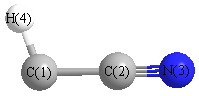 More geometry information
Calculated Bond Angles
| atom1 |
atom2 |
atom3 |
angle |
|
atom1 |
atom2 |
atom3 |
angle |
| C1 |
C2 |
N3 |
175.539 |
|
C2 |
C1 |
H4 |
149.862 |
Electronic energy levels
Charges, Dipole, Quadrupole and Polarizability
Jump to
S1C1
S2C1
S2C2
Energy calculated at TPSSh/6-311G*
| | hartrees |
|---|
| Energy at 0K | -131.461032 |
| Energy at 298.15K | |
| HF Energy | -131.461032 |
| Nuclear repulsion energy | 47.394319 |
The energy at 298.15K was derived from the energy at 0K
and an integrated heat capacity that used the calculated vibrational frequencies.
Vibrational Frequencies calculated at TPSSh/6-311G*
| Mode Number |
Symmetry |
Frequency
(cm-1) |
Scaled Frequency
(cm-1) |
IR Intensities
(km mol-1) |
Raman Act
(Å4/u) |
Dep P |
Dep U |
|---|
| 1 |
Σ |
3441 |
3314 |
53.87 |
|
|
|
| 2 |
Σ |
1731 |
1667 |
38.81 |
|
|
|
| 3 |
Σ |
1254 |
1208 |
5.67 |
|
|
|
| 4 |
Π |
447 |
431 |
0.16 |
|
|
|
| 4 |
Π |
447 |
431 |
0.16 |
|
|
|
| 5 |
Π |
319i |
308i |
50.76 |
|
|
|
| 5 |
Π |
319i |
308i |
50.76 |
|
|
|
Unscaled Zero Point Vibrational Energy (zpe) 3340.3 cm
-1
Scaled (by 0.9632) Zero Point Vibrational Energy (zpe) 3217.4 cm
-1
See section
III.C.1 List or set vibrational scaling factors
to change the scale factors used here.
See section
III.C.2
Calculate a vibrational scaling factor for a given set of molecules
to determine the least squares best scaling factor.
Geometric Data calculated at TPSSh/6-311G*
Point Group is C∞v
Cartesians (Å)
| Atom |
x (Å) |
y (Å) |
z (Å) |
|---|
| C1 |
0.000 |
0.000 |
-1.210 |
| C2 |
0.000 |
0.000 |
0.083 |
| N3 |
0.000 |
0.000 |
1.291 |
| H4 |
0.000 |
0.000 |
-2.275 |
Atom - Atom Distances (Å)
| |
C1 |
C2 |
N3 |
H4 |
| C1 | | 1.2925 | 2.5003 | 1.0657 |
C2 | 1.2925 | | 1.2078 | 2.3583 | N3 | 2.5003 | 1.2078 | | 3.5660 | H4 | 1.0657 | 2.3583 | 3.5660 | |
More geometry information
Calculated Bond Angles
| atom1 |
atom2 |
atom3 |
angle |
|
atom1 |
atom2 |
atom3 |
angle |
| C1 |
C2 |
N3 |
180.000 |
|
C2 |
C1 |
H4 |
180.000 |
Electronic energy levels
Charges, Dipole, Quadrupole and Polarizability
Charges from optimized geometry at TPSSh/6-311G*
Charges (e)
| Number |
Element |
Mulliken |
CHELPG |
AIM |
ESP |
| 1 |
C |
-0.051 |
|
|
|
| 2 |
C |
0.056 |
|
|
|
| 3 |
N |
-0.279 |
|
|
|
| 4 |
H |
0.274 |
|
|
|
Electric dipole moments
Electric dipole components in Debye
(What's a Debye? See section
VII.A.3)
| |
x |
y |
z |
Total |
| |
0.000 |
0.000 |
-3.283 |
3.283 |
| CHELPG |
|
|
|
|
| AIM |
|
|
|
|
| ESP |
|
|
|
|
Electric Quadrupole moment
Quadrupole components in D Å
Polarizabilities
Components of the polarizability tensor.
Units are
Å
3 (Angstrom cubed)
Change units.
| |
x |
y |
z |
| x |
1.904 |
0.000 |
0.000 |
| y |
0.000 |
1.904 |
0.000 |
| z |
0.000 |
0.000 |
6.378 |
<r2> (average value of r
2) Å
2
| <r2> |
36.004 |
| (<r2>)1/2 |
6.000 |
Jump to
S1C1
S1C2
S2C2
Energy calculated at TPSSh/6-311G*
| | hartrees |
|---|
| Energy at 0K | -131.431708 |
| Energy at 298.15K | -131.431150 |
| HF Energy | -131.431708 |
| Nuclear repulsion energy | 46.969655 |
The energy at 298.15K was derived from the energy at 0K
and an integrated heat capacity that used the calculated vibrational frequencies.
Vibrational Frequencies calculated at TPSSh/6-311G*
| Mode Number |
Symmetry |
Frequency
(cm-1) |
Scaled Frequency
(cm-1) |
IR Intensities
(km mol-1) |
Raman Act
(Å4/u) |
Dep P |
Dep U |
|---|
| 1 |
A' |
3061 |
2949 |
14.82 |
|
|
|
| 2 |
A' |
2072 |
1996 |
21.59 |
|
|
|
| 3 |
A' |
1086 |
1046 |
43.45 |
|
|
|
| 4 |
A' |
951 |
916 |
41.47 |
|
|
|
| 5 |
A' |
455 |
438 |
23.54 |
|
|
|
| 6 |
A" |
311 |
300 |
8.54 |
|
|
|
Unscaled Zero Point Vibrational Energy (zpe) 3968.4 cm
-1
Scaled (by 0.9632) Zero Point Vibrational Energy (zpe) 3822.4 cm
-1
See section
III.C.1 List or set vibrational scaling factors
to change the scale factors used here.
See section
III.C.2
Calculate a vibrational scaling factor for a given set of molecules
to determine the least squares best scaling factor.
Geometric Data calculated at TPSSh/6-311G*
Point Group is Cs
Cartesians (Å)
| Atom |
x (Å) |
y (Å) |
z (Å) |
|---|
| C1 |
0.179 |
-1.270 |
0.000 |
| C2 |
0.000 |
0.093 |
0.000 |
| N3 |
-0.332 |
1.228 |
0.000 |
| H4 |
1.248 |
-1.533 |
0.000 |
Atom - Atom Distances (Å)
| |
C1 |
C2 |
N3 |
H4 |
| C1 | | 1.3751 | 2.5498 | 1.1004 |
C2 | 1.3751 | | 1.1822 | 2.0498 | N3 | 2.5498 | 1.1822 | | 3.1809 | H4 | 1.1004 | 2.0498 | 3.1809 | |
More geometry information
Electronic energy levels
Charges, Dipole, Quadrupole and Polarizability
Charges from optimized geometry at TPSSh/6-311G*
Charges (e)
| Number |
Element |
Mulliken |
CHELPG |
AIM |
ESP |
| 1 |
C |
-0.132 |
|
|
|
| 2 |
C |
0.140 |
|
|
|
| 3 |
N |
-0.250 |
|
|
|
| 4 |
H |
0.241 |
|
|
|
Electric dipole moments
Electric dipole components in Debye
(What's a Debye? See section
VII.A.3)
| |
x |
y |
z |
Total |
| |
1.889 |
-1.185 |
0.000 |
2.230 |
| CHELPG |
|
|
|
|
| AIM |
|
|
|
|
| ESP |
|
|
|
|
Electric Quadrupole moment
Quadrupole components in D Å
Polarizabilities
Components of the polarizability tensor.
Units are
Å
3 (Angstrom cubed)
Change units.
| |
x |
y |
z |
| x |
2.764 |
-1.000 |
0.000 |
| y |
-1.000 |
6.283 |
0.000 |
| z |
0.000 |
0.000 |
2.394 |
<r2> (average value of r
2) Å
2
| <r2> |
36.339 |
| (<r2>)1/2 |
6.028 |
Jump to
S1C1
S1C2
S2C1
Energy calculated at TPSSh/6-311G*
| | hartrees |
|---|
| Energy at 0K | -131.431708 |
| Energy at 298.15K | -131.431150 |
| HF Energy | -131.431708 |
| Nuclear repulsion energy | 46.969655 |
The energy at 298.15K was derived from the energy at 0K
and an integrated heat capacity that used the calculated vibrational frequencies.
Vibrational Frequencies calculated at TPSSh/6-311G*
Geometric Data calculated at TPSSh/6-311G*
Point Group is Cs
Electronic energy levels
Charges, Dipole, Quadrupole and Polarizability
