return to home page Computational Chemistry Comparison and Benchmark DataBase Release 22 (May 2022) Standard Reference Database 101 National Institute of Standards and Technology
You are here: Calculated > Energy > Optimized > Energy

All results from a given calculation for CH3COCH2 (Acetonyl radical)

using model chemistry: CCSD(T)/6-311G*

19 10 17 12 22

States and conformations

State Conformation minimum conformation conformer description state description
1 1 yes CS 2A"
Energy calculated at CCSD(T)/6-311G*
 hartrees
Energy at 0K-192.008911
Energy at 298.15K 
HF Energy-191.383211
Nuclear repulsion energy111.410575
The energy at 298.15K was derived from the energy at 0K and an integrated heat capacity that used the calculated vibrational frequencies.
Vibrational Frequencies calculated at CCSD(T)/6-311G*
Mode Number Symmetry Frequency
(cm-1)
Scaled Frequency
(cm-1)
IR Intensities
(km mol-1)
Raman Act
(Å4/u)
Dep P Dep U
1 A' 3257 3135        
2 A' 3142 3024        
3 A' 3138 3021        
4 A' 3028 2915        
5 A' 1640 1579        
6 A' 1496 1440        
7 A' 1471 1416        
8 A' 1417 1364        
9 A' 1276 1228        
10 A' 1072 1031        
11 A' 928 893        
12 A' 824 793        
13 A' 525 505        
14 A' 382 368        
15 A" 3098 2982        
16 A" 1498 1442        
17 A" 1035 997        
18 A" 679 653        
19 A" 500 481        
20 A" 343 330        
21 A" 26i 25i        

Unscaled Zero Point Vibrational Energy (zpe) 15360.4 cm-1
Scaled (by 0.9626) Zero Point Vibrational Energy (zpe) 14785.9 cm-1
See section III.C.1 List or set vibrational scaling factors to change the scale factors used here.
See section III.C.2 Calculate a vibrational scaling factor for a given set of molecules to determine the least squares best scaling factor.
Rotational Constants (cm-1) from geometry optimized at CCSD(T)/6-311G*
ABC
0.36115 0.29983 0.16902

See section I.F.4 to change rotational constant units
Geometric Data calculated at CCSD(T)/6-311G*

Point Group is Cs

Cartesians (Å)
Atom x (Å) y (Å) z (Å)
C1 0.000 0.150 0.000
O2 0.425 1.307 0.000
C3 -1.434 -0.109 0.000
C4 0.941 -1.048 0.000
H5 -2.114 0.739 0.000
H6 -1.840 -1.118 0.000
H7 1.974 -0.691 0.000
H8 0.770 -1.674 0.886
H9 0.770 -1.674 -0.886

Atom - Atom Distances (Å)
  C1 O2 C3 C4 H5 H6 H7 H8 H9
C11.23231.45691.52352.19432.23522.14612.16952.1695
O21.23232.33652.41112.60133.31872.52843.12933.1293
C31.45692.33652.55331.08711.08823.45742.84452.8445
C41.52352.41112.55333.53892.78181.09391.09821.0982
H52.19432.60131.08713.53891.87754.33113.86343.8634
H62.23523.31871.08822.78181.87753.83872.81212.8121
H72.14612.52843.45741.09394.33113.83871.78971.7897
H82.16953.12932.84451.09823.86342.81211.78971.7719
H92.16953.12932.84451.09823.86342.81211.78971.7719

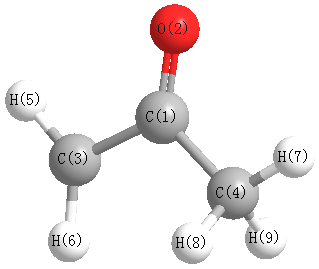
picture of Acetonyl radical state 1 conformation 1
More geometry information
Calculated Bond Angles
atom1 atom2 atom3 angle atom1 atom2 atom3 angle
C1 C3 H5 118.477 C1 C3 H6 122.191
C1 C4 H7 109.052 C1 C4 H8 110.647
C1 C4 H9 110.647 O2 C1 C3 120.413
O2 C1 C4 121.710 C3 C1 C4 117.876
H5 C3 H6 119.331 H7 C4 H8 109.456
H7 C4 H9 109.456 H8 C4 H9 107.559
Electronic energy levels
Charges, Dipole, Quadrupole and Polarizability