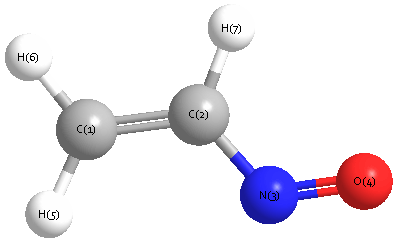
Vibrational Frequencies calculated at TPSSh/6-311G*
| Mode Number |
Symmetry |
Frequency
(cm-1) |
Scaled Frequency
(cm-1) |
IR Intensities
(km mol-1) |
Raman Act
(Å4/u) |
Dep P |
Dep U |
|---|
| 1 |
A' |
3250 |
3130 |
4.00 |
64.27 |
0.70 |
0.82 |
| 2 |
A' |
3160 |
3044 |
7.02 |
168.86 |
0.18 |
0.30 |
| 3 |
A' |
3142 |
3026 |
11.11 |
23.13 |
0.75 |
0.86 |
| 4 |
A' |
1675 |
1614 |
1.60 |
24.37 |
0.12 |
0.21 |
| 5 |
A' |
1565 |
1507 |
116.90 |
48.06 |
0.38 |
0.55 |
| 6 |
A' |
1428 |
1375 |
22.99 |
21.13 |
0.43 |
0.60 |
| 7 |
A' |
1291 |
1244 |
1.66 |
8.45 |
0.43 |
0.60 |
| 8 |
A' |
1144 |
1102 |
72.05 |
24.62 |
0.42 |
0.59 |
| 9 |
A' |
889 |
856 |
33.97 |
0.19 |
0.62 |
0.76 |
| 10 |
A' |
606 |
583 |
1.28 |
8.12 |
0.25 |
0.40 |
| 11 |
A' |
337 |
325 |
1.64 |
1.02 |
0.74 |
0.85 |
| 12 |
A" |
1012 |
975 |
47.19 |
0.18 |
0.75 |
0.86 |
| 13 |
A" |
997 |
960 |
11.42 |
2.73 |
0.75 |
0.86 |
| 14 |
A" |
677 |
652 |
0.91 |
5.51 |
0.75 |
0.86 |
| 15 |
A" |
183 |
176 |
0.09 |
1.03 |
0.75 |
0.86 |
Unscaled Zero Point Vibrational Energy (zpe) 10677.4 cm
-1
Scaled (by 0.9632) Zero Point Vibrational Energy (zpe) 10284.4 cm
-1
See section
III.C.1 List or set vibrational scaling factors
to change the scale factors used here.
See section
III.C.2
Calculate a vibrational scaling factor for a given set of molecules
to determine the least squares best scaling factor.
Charges, Dipole, Quadrupole and Polarizability
Charges from optimized geometry at TPSSh/6-311G*
Charges (e)
| Number |
Element |
Mulliken |
CHELPG |
AIM |
ESP |
| 1 |
C |
-0.374 |
|
|
|
| 2 |
C |
-0.076 |
|
|
|
| 3 |
N |
0.001 |
|
|
|
| 4 |
O |
-0.217 |
|
|
|
| 5 |
H |
0.235 |
|
|
|
| 6 |
H |
0.232 |
|
|
|
| 7 |
H |
0.200 |
|
|
|
Electric dipole moments
Electric dipole components in Debye
(What's a Debye? See section
VII.A.3)
| |
x |
y |
z |
Total |
| |
1.414 |
2.908 |
0.000 |
3.233 |
| CHELPG |
|
|
|
|
| AIM |
|
|
|
|
| ESP |
|
|
|
|
Electric Quadrupole moment
Quadrupole components in D Å
Polarizabilities
Components of the polarizability tensor.
Units are
Å
3 (Angstrom cubed)
Change units.
| |
x |
y |
z |
| x |
6.664 |
2.133 |
0.000 |
| y |
2.133 |
6.169 |
0.000 |
| z |
0.000 |
0.000 |
2.335 |
<r2> (average value of r
2) Å
2
| <r2> |
76.142 |
| (<r2>)1/2 |
8.726 |