Jump to
S1C2
Vibrational Frequencies calculated at CCSD(T)/6-311G*
Geometric Data calculated at CCSD(T)/6-311G*
Electronic energy levels
Charges, Dipole, Quadrupole and Polarizability
Jump to
S1C1
Energy calculated at CCSD(T)/6-311G*
| | hartrees |
|---|
| Energy at 0K | -1071.584951 |
| Energy at 298.15K | |
| HF Energy | -1070.781687 |
| Nuclear repulsion energy | 265.401738 |
The energy at 298.15K was derived from the energy at 0K
and an integrated heat capacity that used the calculated vibrational frequencies.
Vibrational Frequencies calculated at CCSD(T)/6-311G*
| Mode Number |
Symmetry |
Frequency
(cm-1) |
Scaled Frequency
(cm-1) |
IR Intensities
(km mol-1) |
Raman Act
(Å4/u) |
Dep P |
Dep U |
|---|
| 1 |
A |
3106 |
2990 |
|
|
|
|
| 2 |
A |
2961 |
2850 |
|
|
|
|
| 3 |
A |
1810 |
1742 |
|
|
|
|
| 4 |
A |
1416 |
1363 |
|
|
|
|
| 5 |
A |
1301 |
1253 |
|
|
|
|
| 6 |
A |
1270 |
1222 |
|
|
|
|
| 7 |
A |
1038 |
999 |
|
|
|
|
| 8 |
A |
946 |
911 |
|
|
|
|
| 9 |
A |
835 |
804 |
|
|
|
|
| 10 |
A |
654 |
630 |
|
|
|
|
| 11 |
A |
627 |
604 |
|
|
|
|
| 12 |
A |
349 |
336 |
|
|
|
|
| 13 |
A |
284 |
274 |
|
|
|
|
| 14 |
A |
226 |
218 |
|
|
|
|
| 15 |
A |
80 |
77 |
|
|
|
|
Unscaled Zero Point Vibrational Energy (zpe) 8450.9 cm
-1
Scaled (by 0.9626) Zero Point Vibrational Energy (zpe) 8134.8 cm
-1
See section
III.C.1 List or set vibrational scaling factors
to change the scale factors used here.
See section
III.C.2
Calculate a vibrational scaling factor for a given set of molecules
to determine the least squares best scaling factor.
Geometric Data calculated at CCSD(T)/6-311G*
Point Group is C1
Cartesians (Å)
| Atom |
x (Å) |
y (Å) |
z (Å) |
|---|
| C1 |
0.103 |
-0.021 |
0.522 |
| C2 |
-0.716 |
-1.282 |
0.201 |
| H3 |
0.230 |
0.060 |
1.606 |
| Cl4 |
1.737 |
-0.263 |
-0.170 |
| Cl5 |
-0.675 |
1.453 |
-0.057 |
| O6 |
-1.800 |
-1.281 |
-0.323 |
| H7 |
-0.204 |
-2.217 |
0.512 |
Atom - Atom Distances (Å)
| |
C1 |
C2 |
H3 |
Cl4 |
Cl5 |
O6 |
H7 |
| C1 | | 1.5384 | 1.0945 | 1.7908 | 1.7638 | 2.4340 | 2.2175 |
C2 | 1.5384 | | 2.1615 | 2.6826 | 2.7474 | 1.2034 | 1.1101 | H3 | 1.0945 | 2.1615 | | 2.3515 | 2.3503 | 3.1048 | 2.5631 | Cl4 | 1.7908 | 2.6826 | 2.3515 | | 2.9616 | 3.6839 | 2.8373 | Cl5 | 1.7638 | 2.7474 | 2.3503 | 2.9616 | | 2.9684 | 3.7429 | O6 | 2.4340 | 1.2034 | 3.1048 | 3.6839 | 2.9684 | | 2.0294 | H7 | 2.2175 | 1.1101 | 2.5631 | 2.8373 | 3.7429 | 2.0294 | |
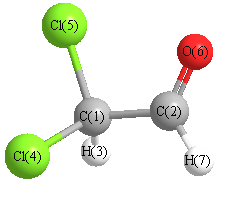 More geometry information
Calculated Bond Angles
| atom1 |
atom2 |
atom3 |
angle |
|
atom1 |
atom2 |
atom3 |
angle |
| C1 |
C2 |
O6 |
124.736 |
|
C1 |
C2 |
H7 |
112.702 |
| C2 |
C1 |
H3 |
109.206 |
|
C2 |
C1 |
Cl4 |
107.131 |
| C2 |
C1 |
Cl5 |
112.432 |
|
H3 |
C1 |
Cl4 |
106.676 |
| H3 |
C1 |
Cl5 |
108.346 |
|
Cl4 |
C1 |
Cl5 |
112.854 |
| O6 |
C2 |
H7 |
122.560 |
|
Electronic energy levels
Charges, Dipole, Quadrupole and Polarizability
