Jump to
S1C2
S1C3
Energy calculated at MP2/3-21G*
| | hartrees |
|---|
| Energy at 0K | -165.007360 |
| Energy at 298.15K | |
| HF Energy | -164.743317 |
| Nuclear repulsion energy | 48.601319 |
The energy at 298.15K was derived from the energy at 0K
and an integrated heat capacity that used the calculated vibrational frequencies.
Vibrational Frequencies calculated at MP2/3-21G*
| Mode Number |
Symmetry |
Frequency
(cm-1) |
Scaled Frequency
(cm-1) |
IR Intensities
(km mol-1) |
Raman Act
(Å4/u) |
Dep P |
Dep U |
|---|
| 1 |
A1 |
3825 |
3639 |
25.45 |
|
|
|
| 2 |
A1 |
818 |
779 |
25.06 |
|
|
|
| 3 |
A1 |
496 |
472 |
249.43 |
|
|
|
| 4 |
A1 |
263 |
250 |
3.33 |
|
|
|
| 5 |
A2 |
179i |
171i |
0.00 |
|
|
|
| 6 |
B1 |
294 |
280 |
120.24 |
|
|
|
| 7 |
B2 |
3823 |
3637 |
183.75 |
|
|
|
| 8 |
B2 |
1705 |
1622 |
257.63 |
|
|
|
| 9 |
B2 |
326 |
310 |
389.33 |
|
|
|
Unscaled Zero Point Vibrational Energy (zpe) 5685.2 cm
-1
Scaled (by 0.9513) Zero Point Vibrational Energy (zpe) 5408.3 cm
-1
See section
III.C.1 List or set vibrational scaling factors
to change the scale factors used here.
See section
III.C.2
Calculate a vibrational scaling factor for a given set of molecules
to determine the least squares best scaling factor.
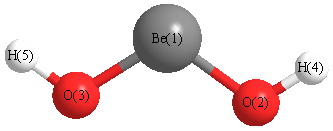
Geometric Data calculated at MP2/3-21G*
Point Group is C2v
Cartesians (Å)
| Atom |
x (Å) |
y (Å) |
z (Å) |
|---|
| Be1 |
0.000 |
0.000 |
0.049 |
| O2 |
0.000 |
1.429 |
0.058 |
| O3 |
0.000 |
-1.429 |
0.058 |
| H4 |
0.000 |
2.172 |
-0.565 |
| H5 |
0.000 |
-2.172 |
-0.565 |
Atom - Atom Distances (Å)
| |
Be1 |
O2 |
O3 |
H4 |
H5 |
| Be1 | | 1.4286 | 1.4286 | 2.2570 | 2.2570 |
O2 | 1.4286 | | 2.8572 | 0.9701 | 3.6541 | O3 | 1.4286 | 2.8572 | | 3.6541 | 0.9701 | H4 | 2.2570 | 0.9701 | 3.6541 | | 4.3440 | H5 | 2.2570 | 3.6541 | 0.9701 | 4.3440 | |
 More geometry information
Calculated Bond Angles
| atom1 |
atom2 |
atom3 |
angle |
|
atom1 |
atom2 |
atom3 |
angle |
| Be1 |
O2 |
H4 |
139.631 |
|
Be1 |
O3 |
H5 |
139.631 |
| O2 |
Be1 |
O3 |
179.224 |
|
Electronic energy levels
Charges, Dipole, Quadrupole and Polarizability
Jump to
S1C1
S1C3
Energy calculated at MP2/3-21G*
| | hartrees |
|---|
| Energy at 0K | -165.007617 |
| Energy at 298.15K | -165.008859 |
| HF Energy | -164.743100 |
| Nuclear repulsion energy | 48.527447 |
The energy at 298.15K was derived from the energy at 0K
and an integrated heat capacity that used the calculated vibrational frequencies.
Vibrational Frequencies calculated at MP2/3-21G*
| Mode Number |
Symmetry |
Frequency
(cm-1) |
Scaled Frequency
(cm-1) |
IR Intensities
(km mol-1) |
Raman Act
(Å4/u) |
Dep P |
Dep U |
|---|
| 1 |
A |
3802 |
3617 |
19.87 |
|
|
|
| 2 |
A |
813 |
774 |
19.70 |
|
|
|
| 3 |
A |
495 |
471 |
210.56 |
|
|
|
| 4 |
A |
261 |
248 |
20.39 |
|
|
|
| 5 |
A |
227 |
216 |
57.92 |
|
|
|
| 6 |
B |
3800 |
3615 |
165.46 |
|
|
|
| 7 |
B |
1697 |
1614 |
252.00 |
|
|
|
| 8 |
B |
432 |
411 |
450.37 |
|
|
|
| 9 |
B |
263 |
250 |
137.57 |
|
|
|
Unscaled Zero Point Vibrational Energy (zpe) 5894.8 cm
-1
Scaled (by 0.9513) Zero Point Vibrational Energy (zpe) 5607.7 cm
-1
See section
III.C.1 List or set vibrational scaling factors
to change the scale factors used here.
See section
III.C.2
Calculate a vibrational scaling factor for a given set of molecules
to determine the least squares best scaling factor.
Geometric Data calculated at MP2/3-21G*
Point Group is C2
Cartesians (Å)
| Atom |
x (Å) |
y (Å) |
z (Å) |
|---|
| Be1 |
0.000 |
0.000 |
-0.061 |
| O2 |
0.000 |
1.432 |
-0.050 |
| O3 |
0.000 |
-1.432 |
-0.050 |
| H4 |
0.358 |
2.131 |
0.522 |
| H5 |
-0.358 |
-2.131 |
0.522 |
Atom - Atom Distances (Å)
| |
Be1 |
O2 |
O3 |
H4 |
H5 |
| Be1 | | 1.4323 | 1.4323 | 2.2386 | 2.2386 |
O2 | 1.4323 | | 2.8645 | 0.9719 | 3.6271 | O3 | 1.4323 | 2.8645 | | 3.6271 | 0.9719 | H4 | 2.2386 | 0.9719 | 3.6271 | | 4.3227 | H5 | 2.2386 | 3.6271 | 0.9719 | 4.3227 | |
More geometry information
Calculated Bond Angles
| atom1 |
atom2 |
atom3 |
angle |
|
atom1 |
atom2 |
atom3 |
angle |
| Be1 |
O2 |
H4 |
136.373 |
|
Be1 |
O3 |
H5 |
136.373 |
| O2 |
Be1 |
O3 |
179.131 |
|
Electronic energy levels
Charges, Dipole, Quadrupole and Polarizability
Jump to
S1C1
S1C2
Energy calculated at MP2/3-21G*
| | hartrees |
|---|
| Energy at 0K | -165.004774 |
| Energy at 298.15K | |
| HF Energy | -164.743995 |
| Nuclear repulsion energy | 49.090254 |
The energy at 298.15K was derived from the energy at 0K
and an integrated heat capacity that used the calculated vibrational frequencies.
Vibrational Frequencies calculated at MP2/3-21G*
| Mode Number |
Symmetry |
Frequency
(cm-1) |
Scaled Frequency
(cm-1) |
IR Intensities
(km mol-1) |
Raman Act
(Å4/u) |
Dep P |
Dep U |
|---|
| 1 |
Σg |
3945 |
3753 |
0.00 |
|
|
|
| 2 |
Σg |
841 |
800 |
0.00 |
|
|
|
| 3 |
Σu |
3942 |
3750 |
406.23 |
|
|
|
| 4 |
Σu |
1769 |
1683 |
350.89 |
|
|
|
| 5 |
Πg |
267i |
254i |
0.00 |
|
|
|
| 5 |
Πg |
267i |
254i |
0.00 |
|
|
|
| 6 |
Πu |
281 |
267 |
17.05 |
|
|
|
| 6 |
Πu |
281 |
267 |
17.05 |
|
|
|
| 7 |
Πu |
337i |
320i |
535.87 |
|
|
|
| 7 |
Πu |
337i |
320i |
535.87 |
|
|
|
Unscaled Zero Point Vibrational Energy (zpe) 4925.1 cm
-1
Scaled (by 0.9513) Zero Point Vibrational Energy (zpe) 4685.2 cm
-1
See section
III.C.1 List or set vibrational scaling factors
to change the scale factors used here.
See section
III.C.2
Calculate a vibrational scaling factor for a given set of molecules
to determine the least squares best scaling factor.
Geometric Data calculated at MP2/3-21G*
Point Group is D∞h
Cartesians (Å)
| Atom |
x (Å) |
y (Å) |
z (Å) |
|---|
| Be1 |
0.000 |
0.000 |
0.000 |
| O2 |
0.000 |
0.000 |
1.406 |
| O3 |
0.000 |
0.000 |
-1.406 |
| H4 |
0.000 |
0.000 |
2.367 |
| H5 |
0.000 |
0.000 |
-2.367 |
Atom - Atom Distances (Å)
| |
Be1 |
O2 |
O3 |
H4 |
H5 |
| Be1 | | 1.4059 | 1.4059 | 2.3667 | 2.3667 |
O2 | 1.4059 | | 2.8119 | 0.9608 | 3.7727 | O3 | 1.4059 | 2.8119 | | 3.7727 | 0.9608 | H4 | 2.3667 | 0.9608 | 3.7727 | | 4.7335 | H5 | 2.3667 | 3.7727 | 0.9608 | 4.7335 | |
More geometry information
Calculated Bond Angles
| atom1 |
atom2 |
atom3 |
angle |
|
atom1 |
atom2 |
atom3 |
angle |
| Be1 |
O2 |
H4 |
180.000 |
|
Be1 |
O3 |
H5 |
180.000 |
| O2 |
Be1 |
O3 |
180.000 |
|
Electronic energy levels
Charges, Dipole, Quadrupole and Polarizability
