Jump to
S1C2
S1C3
Energy calculated at QCISD/3-21G*
| | hartrees |
|---|
| Energy at 0K | -165.015669 |
| Energy at 298.15K | |
| HF Energy | -164.743183 |
| Nuclear repulsion energy | 48.570286 |
The energy at 298.15K was derived from the energy at 0K
and an integrated heat capacity that used the calculated vibrational frequencies.
Vibrational Frequencies calculated at QCISD/3-21G*
| Mode Number |
Symmetry |
Frequency
(cm-1) |
Scaled Frequency
(cm-1) |
IR Intensities
(km mol-1) |
Raman Act
(Å4/u) |
Dep P |
Dep U |
|---|
| 1 |
A1 |
3796 |
3648 |
18.02 |
|
|
|
| 2 |
A1 |
815 |
784 |
25.60 |
|
|
|
| 3 |
A1 |
496 |
476 |
246.98 |
|
|
|
| 4 |
A1 |
262 |
252 |
2.27 |
|
|
|
| 5 |
A2 |
198i |
190i |
0.00 |
|
|
|
| 6 |
B1 |
288 |
277 |
113.20 |
|
|
|
| 7 |
B2 |
3794 |
3646 |
136.36 |
|
|
|
| 8 |
B2 |
1699 |
1633 |
255.05 |
|
|
|
| 9 |
B2 |
320 |
308 |
394.20 |
|
|
|
Unscaled Zero Point Vibrational Energy (zpe) 5636.0 cm
-1
Scaled (by 0.9611) Zero Point Vibrational Energy (zpe) 5416.7 cm
-1
See section
III.C.1 List or set vibrational scaling factors
to change the scale factors used here.
See section
III.C.2
Calculate a vibrational scaling factor for a given set of molecules
to determine the least squares best scaling factor.
Geometric Data calculated at QCISD/3-21G*
Point Group is C2v
Cartesians (Å)
| Atom |
x (Å) |
y (Å) |
z (Å) |
|---|
| Be1 |
0.000 |
0.000 |
0.043 |
| O2 |
0.000 |
1.429 |
0.060 |
| O3 |
0.000 |
-1.429 |
0.060 |
| H4 |
0.000 |
2.175 |
-0.563 |
| H5 |
0.000 |
-2.175 |
-0.563 |
Atom - Atom Distances (Å)
| |
Be1 |
O2 |
O3 |
H4 |
H5 |
| Be1 | | 1.4294 | 1.4294 | 2.2579 | 2.2579 |
O2 | 1.4294 | | 2.8586 | 0.9712 | 3.6577 | O3 | 1.4294 | 2.8586 | | 3.6577 | 0.9712 | H4 | 2.2579 | 0.9712 | 3.6577 | | 4.3503 | H5 | 2.2579 | 3.6577 | 0.9712 | 4.3503 | |
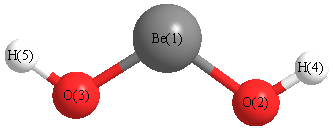 More geometry information
Calculated Bond Angles
| atom1 |
atom2 |
atom3 |
angle |
|
atom1 |
atom2 |
atom3 |
angle |
| Be1 |
O2 |
H4 |
139.511 |
|
Be1 |
O3 |
H5 |
139.511 |
| O2 |
Be1 |
O3 |
178.679 |
|
Electronic energy levels
Charges, Dipole, Quadrupole and Polarizability
Jump to
S1C1
S1C3
Energy calculated at QCISD/3-21G*
| | hartrees |
|---|
| Energy at 0K | -165.016026 |
| Energy at 298.15K | -165.017300 |
| HF Energy | -164.742873 |
| Nuclear repulsion energy | 48.476336 |
The energy at 298.15K was derived from the energy at 0K
and an integrated heat capacity that used the calculated vibrational frequencies.
Vibrational Frequencies calculated at QCISD/3-21G*
| Mode Number |
Symmetry |
Frequency
(cm-1) |
Scaled Frequency
(cm-1) |
IR Intensities
(km mol-1) |
Raman Act
(Å4/u) |
Dep P |
Dep U |
|---|
| 1 |
A |
3764 |
3618 |
13.00 |
|
|
|
| 2 |
A |
809 |
778 |
19.19 |
|
|
|
| 3 |
A |
497 |
478 |
196.84 |
|
|
|
| 4 |
A |
265 |
255 |
53.84 |
|
|
|
| 5 |
A |
243 |
234 |
40.00 |
|
|
|
| 6 |
B |
3764 |
3618 |
115.53 |
|
|
|
| 7 |
B |
1689 |
1623 |
247.69 |
|
|
|
| 8 |
B |
444 |
427 |
464.63 |
|
|
|
| 9 |
B |
258 |
248 |
132.58 |
|
|
|
Unscaled Zero Point Vibrational Energy (zpe) 5866.6 cm
-1
Scaled (by 0.9611) Zero Point Vibrational Energy (zpe) 5638.3 cm
-1
See section
III.C.1 List or set vibrational scaling factors
to change the scale factors used here.
See section
III.C.2
Calculate a vibrational scaling factor for a given set of molecules
to determine the least squares best scaling factor.
Geometric Data calculated at QCISD/3-21G*
Point Group is C2
Cartesians (Å)
| Atom |
x (Å) |
y (Å) |
z (Å) |
|---|
| Be1 |
0.000 |
0.000 |
-0.058 |
| O2 |
0.000 |
1.434 |
-0.050 |
| O3 |
0.000 |
-1.434 |
-0.050 |
| H4 |
0.389 |
2.127 |
0.513 |
| H5 |
-0.389 |
-2.127 |
0.513 |
Atom - Atom Distances (Å)
| |
Be1 |
O2 |
O3 |
H4 |
H5 |
| Be1 | | 1.4339 | 1.4339 | 2.2362 | 2.2362 |
O2 | 1.4339 | | 2.8678 | 0.9735 | 3.6256 | O3 | 1.4339 | 2.8678 | | 3.6256 | 0.9735 | H4 | 2.2362 | 0.9735 | 3.6256 | | 4.3238 | H5 | 2.2362 | 3.6256 | 0.9735 | 4.3238 | |
More geometry information
Calculated Bond Angles
| atom1 |
atom2 |
atom3 |
angle |
|
atom1 |
atom2 |
atom3 |
angle |
| Be1 |
O2 |
H4 |
135.656 |
|
Be1 |
O3 |
H5 |
135.656 |
| O2 |
Be1 |
O3 |
179.293 |
|
Electronic energy levels
Charges, Dipole, Quadrupole and Polarizability
Jump to
S1C1
S1C2
Energy calculated at QCISD/3-21G*
| | hartrees |
|---|
| Energy at 0K | -165.013006 |
| Energy at 298.15K | |
| HF Energy | -164.743949 |
| Nuclear repulsion energy | 49.085287 |
The energy at 298.15K was derived from the energy at 0K
and an integrated heat capacity that used the calculated vibrational frequencies.
Vibrational Frequencies calculated at QCISD/3-21G*
| Mode Number |
Symmetry |
Frequency
(cm-1) |
Scaled Frequency
(cm-1) |
IR Intensities
(km mol-1) |
Raman Act
(Å4/u) |
Dep P |
Dep U |
|---|
| 1 |
Σg |
3926 |
3774 |
0.00 |
|
|
|
| 2 |
Σg |
840 |
807 |
0.00 |
|
|
|
| 3 |
Σu |
3924 |
3771 |
338.33 |
|
|
|
| 4 |
Σu |
1767 |
1698 |
353.59 |
|
|
|
| 5 |
Πg |
277i |
266i |
0.00 |
|
|
|
| 5 |
Πg |
277i |
266i |
0.00 |
|
|
|
| 6 |
Πu |
277 |
266 |
15.18 |
|
|
|
| 6 |
Πu |
277 |
266 |
15.18 |
|
|
|
| 7 |
Πu |
342i |
329i |
537.96 |
|
|
|
| 7 |
Πu |
342i |
329i |
537.96 |
|
|
|
Unscaled Zero Point Vibrational Energy (zpe) 4887.1 cm
-1
Scaled (by 0.9611) Zero Point Vibrational Energy (zpe) 4697.0 cm
-1
See section
III.C.1 List or set vibrational scaling factors
to change the scale factors used here.
See section
III.C.2
Calculate a vibrational scaling factor for a given set of molecules
to determine the least squares best scaling factor.
Geometric Data calculated at QCISD/3-21G*
Point Group is D∞h
Cartesians (Å)
| Atom |
x (Å) |
y (Å) |
z (Å) |
|---|
| Be1 |
0.000 |
0.000 |
0.000 |
| O2 |
0.000 |
0.000 |
1.406 |
| O3 |
0.000 |
0.000 |
-1.406 |
| H4 |
0.000 |
0.000 |
2.367 |
| H5 |
0.000 |
0.000 |
-2.367 |
Atom - Atom Distances (Å)
| |
Be1 |
O2 |
O3 |
H4 |
H5 |
| Be1 | | 1.4059 | 1.4059 | 2.3673 | 2.3673 |
O2 | 1.4059 | | 2.8118 | 0.9614 | 3.7732 | O3 | 1.4059 | 2.8118 | | 3.7732 | 0.9614 | H4 | 2.3673 | 0.9614 | 3.7732 | | 4.7346 | H5 | 2.3673 | 3.7732 | 0.9614 | 4.7346 | |
More geometry information
Calculated Bond Angles
| atom1 |
atom2 |
atom3 |
angle |
|
atom1 |
atom2 |
atom3 |
angle |
| Be1 |
O2 |
H4 |
180.000 |
|
Be1 |
O3 |
H5 |
180.000 |
| O2 |
Be1 |
O3 |
180.000 |
|
Electronic energy levels
Charges, Dipole, Quadrupole and Polarizability
