Jump to
S1C2
S1C3
Energy calculated at wB97X-D/3-21G*
| | hartrees |
|---|
| Energy at 0K | -253.583976 |
| Energy at 298.15K | -253.583536 |
| HF Energy | -253.583976 |
| Nuclear repulsion energy | 46.894701 |
The energy at 298.15K was derived from the energy at 0K
and an integrated heat capacity that used the calculated vibrational frequencies.
Geometric Data calculated at wB97X-D/3-21G*
Point Group is C∞v
Cartesians (Å)
| Atom |
x (Å) |
y (Å) |
z (Å) |
|---|
| C1 |
0.000 |
0.000 |
-0.674 |
| N2 |
0.000 |
0.000 |
-1.846 |
| Na3 |
0.000 |
0.000 |
1.542 |
Atom - Atom Distances (Å)
| |
C1 |
N2 |
Na3 |
| C1 | | 1.1717 | 2.2163 |
N2 | 1.1717 | | 3.3881 | Na3 | 2.2163 | 3.3881 | |
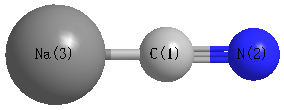 More geometry information
Calculated Bond Angles
| atom1 |
atom2 |
atom3 |
angle |
|
atom1 |
atom2 |
atom3 |
angle |
| C1 |
N2 |
Na3 |
0.000 |
|
C1 |
Na3 |
N2 |
0.000 |
| N2 |
C1 |
Na3 |
180.000 |
|
Electronic energy levels
Charges, Dipole, Quadrupole and Polarizability
Charges from optimized geometry at wB97X-D/3-21G*
Charges (e)
| Number |
Element |
Mulliken |
CHELPG |
AIM |
ESP |
| 1 |
C |
-0.159 |
|
|
|
| 2 |
N |
-0.455 |
|
|
|
| 3 |
Na |
0.613 |
|
|
|
Electric dipole moments
Electric dipole components in Debye
(What's a Debye? See section
VII.A.3)
| |
x |
y |
z |
Total |
| |
0.000 |
0.000 |
10.270 |
10.270 |
| CHELPG |
|
|
|
|
| AIM |
|
|
|
|
| ESP |
|
|
|
|
Electric Quadrupole moment
Quadrupole components in D Å
| Primitive |
|---|
| | x | y | z |
|---|
| x |
-17.171 |
0.000 |
0.000 |
| y |
0.000 |
-17.171 |
0.000 |
| z |
0.000 |
0.000 |
-12.989 |
|
| Traceless |
|---|
| | x | y | z |
|---|
| x |
-2.091 |
0.000 |
0.000 |
| y |
0.000 |
-2.091 |
0.000 |
| z |
0.000 |
0.000 |
4.182 |
|
| Polar |
|---|
| 3z2-r2 | 8.364 |
|---|
| x2-y2 | 0.000 |
|---|
| xy | 0.000 |
|---|
| xz | 0.000 |
|---|
| yz | 0.000 |
|---|
|
Polarizabilities
Components of the polarizability tensor.
Units are
Å
3 (Angstrom cubed)
Change units.
| |
x |
y |
z |
| x |
2.517 |
0.000 |
0.000 |
| y |
0.000 |
2.517 |
0.000 |
| z |
0.000 |
0.000 |
4.571 |
<r2> (average value of r
2) Å
2
| <r2> |
62.095 |
| (<r2>)1/2 |
7.880 |
Jump to
S1C1
S1C3
Energy calculated at wB97X-D/3-21G*
| | hartrees |
|---|
| Energy at 0K | -253.588388 |
| Energy at 298.15K | -253.588100 |
| HF Energy | -253.588388 |
| Nuclear repulsion energy | 51.025959 |
The energy at 298.15K was derived from the energy at 0K
and an integrated heat capacity that used the calculated vibrational frequencies.
Geometric Data calculated at wB97X-D/3-21G*
Point Group is Cs
Cartesians (Å)
| Atom |
x (Å) |
y (Å) |
z (Å) |
|---|
| C1 |
1.132 |
0.690 |
0.000 |
| N2 |
0.000 |
1.051 |
0.000 |
| Na3 |
-0.617 |
-1.045 |
0.000 |
Atom - Atom Distances (Å)
| |
C1 |
N2 |
Na3 |
| C1 | | 1.1879 | 2.4638 |
N2 | 1.1879 | | 2.1858 | Na3 | 2.4638 | 2.1858 | |
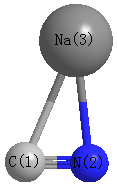 More geometry information
Calculated Bond Angles
| atom1 |
atom2 |
atom3 |
angle |
|
atom1 |
atom2 |
atom3 |
angle |
| C1 |
N2 |
Na3 |
88.695 |
|
C1 |
Na3 |
N2 |
28.818 |
| N2 |
C1 |
Na3 |
62.487 |
|
Electronic energy levels
Charges, Dipole, Quadrupole and Polarizability
Charges from optimized geometry at wB97X-D/3-21G*
Charges (e)
| Number |
Element |
Mulliken |
CHELPG |
AIM |
ESP |
| 1 |
C |
0.021 |
|
|
|
| 2 |
N |
-0.536 |
|
|
|
| 3 |
Na |
0.515 |
|
|
|
Electric dipole moments
Electric dipole components in Debye
(What's a Debye? See section
VII.A.3)
| |
x |
y |
z |
Total |
| |
-4.753 |
-7.731 |
0.000 |
9.075 |
| CHELPG |
|
|
|
|
| AIM |
|
|
|
|
| ESP |
|
|
|
|
Electric Quadrupole moment
Quadrupole components in D Å
| Primitive |
|---|
| | x | y | z |
|---|
| x |
-20.407 |
2.429 |
0.000 |
| y |
2.429 |
-13.476 |
0.000 |
| z |
0.000 |
0.000 |
-17.432 |
|
| Traceless |
|---|
| | x | y | z |
|---|
| x |
-4.952 |
2.429 |
0.000 |
| y |
2.429 |
5.443 |
0.000 |
| z |
0.000 |
0.000 |
-0.491 |
|
| Polar |
|---|
| 3z2-r2 | -0.981 |
|---|
| x2-y2 | -6.930 |
|---|
| xy | 2.429 |
|---|
| xz | 0.000 |
|---|
| yz | 0.000 |
|---|
|
Polarizabilities
Components of the polarizability tensor.
Units are
Å
3 (Angstrom cubed)
Change units.
| |
x |
y |
z |
| x |
3.776 |
0.217 |
0.000 |
| y |
0.217 |
2.933 |
0.000 |
| z |
0.000 |
0.000 |
2.571 |
<r2> (average value of r
2) Å
2
| <r2> |
47.293 |
| (<r2>)1/2 |
6.877 |
Jump to
S1C1
S1C2
Energy calculated at wB97X-D/3-21G*
| | hartrees |
|---|
| Energy at 0K | -253.587706 |
| Energy at 298.15K | -253.586955 |
| HF Energy | -253.587706 |
| Nuclear repulsion energy | 49.353344 |
The energy at 298.15K was derived from the energy at 0K
and an integrated heat capacity that used the calculated vibrational frequencies.
Geometric Data calculated at wB97X-D/3-21G*
Point Group is C∞v
Cartesians (Å)
| Atom |
x (Å) |
y (Å) |
z (Å) |
|---|
| C1 |
0.000 |
0.000 |
-1.855 |
| N2 |
0.000 |
0.000 |
-0.675 |
| Na3 |
0.000 |
0.000 |
1.441 |
Atom - Atom Distances (Å)
| |
C1 |
N2 |
Na3 |
| C1 | | 1.1808 | 3.2969 |
N2 | 1.1808 | | 2.1161 | Na3 | 3.2969 | 2.1161 | |
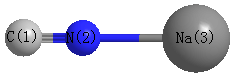 More geometry information
Calculated Bond Angles
| atom1 |
atom2 |
atom3 |
angle |
|
atom1 |
atom2 |
atom3 |
angle |
| C1 |
N2 |
Na3 |
180.000 |
|
C1 |
Na3 |
N2 |
0.000 |
| N2 |
C1 |
Na3 |
0.000 |
|
Electronic energy levels
Charges, Dipole, Quadrupole and Polarizability
Charges from optimized geometry at wB97X-D/3-21G*
Charges (e)
| Number |
Element |
Mulliken |
CHELPG |
AIM |
ESP |
| 1 |
C |
0.028 |
|
|
|
| 2 |
N |
-0.613 |
|
|
|
| 3 |
Na |
0.585 |
|
|
|
Electric dipole moments
Electric dipole components in Debye
(What's a Debye? See section
VII.A.3)
| |
x |
y |
z |
Total |
| |
0.000 |
0.000 |
10.258 |
10.258 |
| CHELPG |
|
|
|
|
| AIM |
|
|
|
|
| ESP |
|
|
|
|
Electric Quadrupole moment
Quadrupole components in D Å
| Primitive |
|---|
| | x | y | z |
|---|
| x |
-17.071 |
0.000 |
0.000 |
| y |
0.000 |
-17.071 |
0.000 |
| z |
0.000 |
0.000 |
-15.575 |
|
| Traceless |
|---|
| | x | y | z |
|---|
| x |
-0.748 |
0.000 |
0.000 |
| y |
0.000 |
-0.748 |
0.000 |
| z |
0.000 |
0.000 |
1.496 |
|
| Polar |
|---|
| 3z2-r2 | 2.992 |
|---|
| x2-y2 | 0.000 |
|---|
| xy | 0.000 |
|---|
| xz | 0.000 |
|---|
| yz | 0.000 |
|---|
|
Polarizabilities
Components of the polarizability tensor.
Units are
Å
3 (Angstrom cubed)
Change units.
| |
x |
y |
z |
| x |
2.368 |
0.000 |
0.000 |
| y |
0.000 |
2.368 |
0.000 |
| z |
0.000 |
0.000 |
4.586 |
<r2> (average value of r
2) Å
2
| <r2> |
55.265 |
| (<r2>)1/2 |
7.434 |
