Jump to
S1C2
Energy calculated at wB97X-D/3-21G*
| | hartrees |
|---|
| Energy at 0K | -130.643876 |
| Energy at 298.15K | -130.643266 |
| HF Energy | -130.643876 |
| Nuclear repulsion energy | 47.395436 |
The energy at 298.15K was derived from the energy at 0K
and an integrated heat capacity that used the calculated vibrational frequencies.
Vibrational Frequencies calculated at wB97X-D/3-21G*
| Mode Number |
Symmetry |
Frequency
(cm-1) |
Scaled Frequency
(cm-1) |
IR Intensities
(km mol-1) |
Raman Act
(Å4/u) |
Dep P |
Dep U |
|---|
| 1 |
A' |
3458 |
3277 |
61.54 |
|
|
|
| 2 |
A' |
1688 |
1600 |
38.72 |
|
|
|
| 3 |
A' |
1285 |
1218 |
3.84 |
|
|
|
| 4 |
A' |
607 |
576 |
15.00 |
|
|
|
| 5 |
A' |
364 |
345 |
48.04 |
|
|
|
| 6 |
A" |
457 |
433 |
12.26 |
|
|
|
Unscaled Zero Point Vibrational Energy (zpe) 3929.3 cm
-1
Scaled (by 0.9478) Zero Point Vibrational Energy (zpe) 3724.2 cm
-1
See section
III.C.1 List or set vibrational scaling factors
to change the scale factors used here.
See section
III.C.2
Calculate a vibrational scaling factor for a given set of molecules
to determine the least squares best scaling factor.
Geometric Data calculated at wB97X-D/3-21G*
Point Group is Cs
Cartesians (Å)
| Atom |
x (Å) |
y (Å) |
z (Å) |
|---|
| C1 |
-0.755 |
-0.974 |
0.000 |
| C2 |
0.000 |
0.106 |
0.000 |
| N3 |
0.755 |
1.036 |
0.000 |
| H4 |
-0.754 |
-2.048 |
0.000 |
Atom - Atom Distances (Å)
| |
C1 |
C2 |
N3 |
H4 |
| C1 | | 1.3174 | 2.5133 | 1.0740 |
C2 | 1.3174 | | 1.1975 | 2.2819 | N3 | 2.5133 | 1.1975 | | 3.4328 | H4 | 1.0740 | 2.2819 | 3.4328 | |
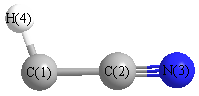 More geometry information
Calculated Bond Angles
| atom1 |
atom2 |
atom3 |
angle |
|
atom1 |
atom2 |
atom3 |
angle |
| C1 |
C2 |
N3 |
175.891 |
|
C2 |
C1 |
H4 |
144.997 |
Electronic energy levels
Charges, Dipole, Quadrupole and Polarizability
Charges from optimized geometry at wB97X-D/3-21G*
Charges (e)
| Number |
Element |
Mulliken |
CHELPG |
AIM |
ESP |
| 1 |
C |
0.024 |
|
|
|
| 2 |
C |
0.109 |
|
|
|
| 3 |
N |
-0.467 |
|
|
|
| 4 |
H |
0.333 |
|
|
|
Electric dipole moments
Electric dipole components in Debye
(What's a Debye? See section
VII.A.3)
| |
x |
y |
z |
Total |
| |
0.002 |
-3.156 |
0.000 |
3.156 |
| CHELPG |
|
|
|
|
| AIM |
|
|
|
|
| ESP |
|
|
|
|
Electric Quadrupole moment
Quadrupole components in D Å
| Primitive |
|---|
| | x | y | z |
|---|
| x |
-17.099 |
-0.001 |
0.000 |
| y |
-0.001 |
-15.416 |
0.000 |
| z |
0.000 |
0.000 |
-17.099 |
|
| Traceless |
|---|
| | x | y | z |
|---|
| x |
-0.841 |
-0.001 |
0.000 |
| y |
-0.001 |
1.683 |
0.000 |
| z |
0.000 |
0.000 |
-0.841 |
|
| Polar |
|---|
| 3z2-r2 | -1.683 |
|---|
| x2-y2 | -1.683 |
|---|
| xy | -0.001 |
|---|
| xz | 0.000 |
|---|
| yz | 0.000 |
|---|
|
Polarizabilities
Components of the polarizability tensor.
Units are
Å
3 (Angstrom cubed)
Change units.
| |
x |
y |
z |
| x |
1.269 |
-0.002 |
0.000 |
| y |
-0.002 |
5.539 |
0.000 |
| z |
0.000 |
0.000 |
1.269 |
<r2> (average value of r
2) Å
2
| <r2> |
35.949 |
| (<r2>)1/2 |
5.996 |
Jump to
S1C1
Energy calculated at wB97X-D/3-21G*
| | hartrees |
|---|
| Energy at 0K | -130.643876 |
| Energy at 298.15K | -130.643461 |
| HF Energy | -130.643876 |
| Nuclear repulsion energy | 47.395363 |
The energy at 298.15K was derived from the energy at 0K
and an integrated heat capacity that used the calculated vibrational frequencies.
Vibrational Frequencies calculated at wB97X-D/3-21G*
| Mode Number |
Symmetry |
Frequency
(cm-1) |
Scaled Frequency
(cm-1) |
IR Intensities
(km mol-1) |
Raman Act
(Å4/u) |
Dep P |
Dep U |
|---|
| 1 |
Σ |
3457 |
3277 |
61.54 |
|
|
|
| 2 |
Σ |
1688 |
1600 |
38.74 |
|
|
|
| 3 |
Σ |
1285 |
1218 |
3.83 |
|
|
|
| 4 |
Π |
607 |
576 |
15.04 |
|
|
|
| 4 |
Π |
607 |
576 |
15.04 |
|
|
|
| 5 |
Π |
365 |
346 |
48.00 |
|
|
|
| 5 |
Π |
365 |
346 |
48.00 |
|
|
|
Unscaled Zero Point Vibrational Energy (zpe) 4187.2 cm
-1
Scaled (by 0.9478) Zero Point Vibrational Energy (zpe) 3968.6 cm
-1
See section
III.C.1 List or set vibrational scaling factors
to change the scale factors used here.
See section
III.C.2
Calculate a vibrational scaling factor for a given set of molecules
to determine the least squares best scaling factor.
Geometric Data calculated at wB97X-D/3-21G*
Point Group is C∞v
Cartesians (Å)
| Atom |
x (Å) |
y (Å) |
z (Å) |
|---|
| C1 |
0.000 |
0.000 |
-1.210 |
| C2 |
0.000 |
0.000 |
0.085 |
| N3 |
0.000 |
0.000 |
1.289 |
| H4 |
0.000 |
0.000 |
-2.275 |
Atom - Atom Distances (Å)
| |
C1 |
C2 |
N3 |
H4 |
| C1 | | 1.2950 | 2.4982 | 1.0659 |
C2 | 1.2950 | | 1.2032 | 2.3609 | N3 | 2.4982 | 1.2032 | | 3.5641 | H4 | 1.0659 | 2.3609 | 3.5641 | |
More geometry information
Calculated Bond Angles
| atom1 |
atom2 |
atom3 |
angle |
|
atom1 |
atom2 |
atom3 |
angle |
| C1 |
C2 |
N3 |
180.000 |
|
C2 |
C1 |
H4 |
180.000 |
Electronic energy levels
Charges, Dipole, Quadrupole and Polarizability
Charges from optimized geometry at wB97X-D/3-21G*
Charges (e)
| Number |
Element |
Mulliken |
CHELPG |
AIM |
ESP |
| 1 |
C |
0.024 |
|
|
|
| 2 |
C |
0.109 |
|
|
|
| 3 |
N |
-0.467 |
|
|
|
| 4 |
H |
0.333 |
|
|
|
Electric dipole moments
Electric dipole components in Debye
(What's a Debye? See section
VII.A.3)
| |
x |
y |
z |
Total |
| |
0.000 |
0.000 |
-3.156 |
3.156 |
| CHELPG |
|
|
|
|
| AIM |
|
|
|
|
| ESP |
|
|
|
|
Electric Quadrupole moment
Quadrupole components in D Å
| Primitive |
|---|
| | x | y | z |
|---|
| x |
-17.099 |
0.000 |
0.000 |
| y |
0.000 |
-17.099 |
0.000 |
| z |
0.000 |
0.000 |
-15.415 |
|
| Traceless |
|---|
| | x | y | z |
|---|
| x |
-0.842 |
0.000 |
0.000 |
| y |
0.000 |
-0.842 |
0.000 |
| z |
0.000 |
0.000 |
1.683 |
|
| Polar |
|---|
| 3z2-r2 | 3.367 |
|---|
| x2-y2 | 0.000 |
|---|
| xy | 0.000 |
|---|
| xz | 0.000 |
|---|
| yz | 0.000 |
|---|
|
Polarizabilities
Components of the polarizability tensor.
Units are
Å
3 (Angstrom cubed)
Change units.
| |
x |
y |
z |
| x |
1.269 |
0.000 |
0.000 |
| y |
0.000 |
1.269 |
0.000 |
| z |
0.000 |
0.000 |
5.539 |
<r2> (average value of r
2) Å
2
| <r2> |
35.949 |
| (<r2>)1/2 |
5.996 |
