Jump to
S1C2
Energy calculated at LSDA/3-21G*
| | hartrees |
|---|
| Energy at 0K | -166.761587 |
| Energy at 298.15K | -166.762676 |
| HF Energy | -166.761587 |
| Nuclear repulsion energy | 59.377349 |
The energy at 298.15K was derived from the energy at 0K
and an integrated heat capacity that used the calculated vibrational frequencies.
Vibrational Frequencies calculated at LSDA/3-21G*
| Mode Number |
Symmetry |
Frequency
(cm-1) |
Scaled Frequency
(cm-1) |
IR Intensities
(km mol-1) |
Raman Act
(Å4/u) |
Dep P |
Dep U |
|---|
| 1 |
Σ |
3476 |
3414 |
219.75 |
|
|
|
| 2 |
Σ |
2270 |
2229 |
152.63 |
|
|
|
| 3 |
Σ |
1193 |
1171 |
51.98 |
|
|
|
| 4 |
Π |
583 |
573 |
41.17 |
|
|
|
| 4 |
Π |
583 |
573 |
41.17 |
|
|
|
| 5 |
Π |
528 |
519 |
79.75 |
|
|
|
| 5 |
Π |
528 |
519 |
79.75 |
|
|
|
Unscaled Zero Point Vibrational Energy (zpe) 4580.4 cm
-1
Scaled (by 0.982) Zero Point Vibrational Energy (zpe) 4498.0 cm
-1
See section
III.C.1 List or set vibrational scaling factors
to change the scale factors used here.
See section
III.C.2
Calculate a vibrational scaling factor for a given set of molecules
to determine the least squares best scaling factor.
Geometric Data calculated at LSDA/3-21G*
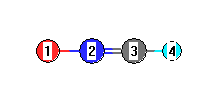
Point Group is C∞v
Cartesians (Å)
| Atom |
x (Å) |
y (Å) |
z (Å) |
|---|
| O1 |
0.000 |
0.000 |
1.206 |
| N2 |
0.000 |
0.000 |
-0.024 |
| C3 |
0.000 |
0.000 |
-1.201 |
| H4 |
0.000 |
0.000 |
-2.269 |
Atom - Atom Distances (Å)
| |
O1 |
N2 |
C3 |
H4 |
| O1 | | 1.2299 | 2.4066 | 3.4749 |
N2 | 1.2299 | | 1.1767 | 2.2450 | C3 | 2.4066 | 1.1767 | | 1.0683 | H4 | 3.4749 | 2.2450 | 1.0683 | |
 More geometry information
Calculated Bond Angles
| atom1 |
atom2 |
atom3 |
angle |
|
atom1 |
atom2 |
atom3 |
angle |
| O1 |
N2 |
C3 |
180.000 |
|
N2 |
C3 |
H4 |
180.000 |
Electronic energy levels
Charges, Dipole, Quadrupole and Polarizability
Charges from optimized geometry at LSDA/3-21G*
Charges (e)
| Number |
Element |
Mulliken |
CHELPG |
AIM |
ESP |
| 1 |
O |
-0.343 |
|
|
|
| 2 |
N |
-0.128 |
|
|
|
| 3 |
C |
0.136 |
|
|
|
| 4 |
H |
0.335 |
|
|
|
Electric dipole moments
Electric dipole components in Debye
(What's a Debye? See section
VII.A.3)
| |
x |
y |
z |
Total |
| |
0.000 |
0.000 |
-2.626 |
2.626 |
| CHELPG |
|
|
|
|
| AIM |
|
|
|
|
| ESP |
|
|
|
|
Electric Quadrupole moment
Quadrupole components in D Å
| Primitive |
|---|
| | x | y | z |
|---|
| x |
-16.514 |
0.000 |
0.000 |
| y |
0.000 |
-16.514 |
0.000 |
| z |
0.000 |
0.000 |
-13.874 |
|
| Traceless |
|---|
| | x | y | z |
|---|
| x |
-1.320 |
0.000 |
0.000 |
| y |
0.000 |
-1.320 |
0.000 |
| z |
0.000 |
0.000 |
2.640 |
|
| Polar |
|---|
| 3z2-r2 | 5.281 |
|---|
| x2-y2 | 0.000 |
|---|
| xy | 0.000 |
|---|
| xz | 0.000 |
|---|
| yz | 0.000 |
|---|
|
Polarizabilities
Components of the polarizability tensor.
Units are
Å
3 (Angstrom cubed)
Change units.
| |
x |
y |
z |
| x |
0.950 |
0.000 |
0.000 |
| y |
0.000 |
0.950 |
0.000 |
| z |
0.000 |
0.000 |
5.169 |
<r2> (average value of r
2) Å
2
| <r2> |
35.201 |
| (<r2>)1/2 |
5.933 |
Jump to
S1C1
Energy calculated at LSDA/3-21G*
| | hartrees |
|---|
| Energy at 0K | -166.761586 |
| Energy at 298.15K | -166.762445 |
| HF Energy | -166.761586 |
| Nuclear repulsion energy | 59.378277 |
The energy at 298.15K was derived from the energy at 0K
and an integrated heat capacity that used the calculated vibrational frequencies.
Vibrational Frequencies calculated at LSDA/3-21G*
| Mode Number |
Symmetry |
Frequency
(cm-1) |
Scaled Frequency
(cm-1) |
IR Intensities
(km mol-1) |
Raman Act
(Å4/u) |
Dep P |
Dep U |
|---|
| 1 |
A' |
3477 |
3414 |
219.76 |
|
|
|
| 2 |
A' |
2270 |
2229 |
152.47 |
|
|
|
| 3 |
A' |
1192 |
1171 |
52.03 |
|
|
|
| 4 |
A' |
583 |
572 |
41.07 |
|
|
|
| 5 |
A' |
528 |
519 |
79.81 |
|
|
|
| 6 |
A" |
582 |
571 |
59.97 |
|
|
|
Unscaled Zero Point Vibrational Energy (zpe) 4315.8 cm
-1
Scaled (by 0.982) Zero Point Vibrational Energy (zpe) 4238.1 cm
-1
See section
III.C.1 List or set vibrational scaling factors
to change the scale factors used here.
See section
III.C.2
Calculate a vibrational scaling factor for a given set of molecules
to determine the least squares best scaling factor.
Geometric Data calculated at LSDA/3-21G*
Point Group is Cs
Cartesians (Å)
| Atom |
x (Å) |
y (Å) |
z (Å) |
|---|
| O1 |
-0.014 |
-1.206 |
0.000 |
| N2 |
0.000 |
0.024 |
0.000 |
| C3 |
0.014 |
1.201 |
0.000 |
| H4 |
0.028 |
2.269 |
0.000 |
Atom - Atom Distances (Å)
| |
O1 |
N2 |
C3 |
H4 |
| O1 | | 1.2300 | 2.4065 | 3.4748 |
N2 | 1.2300 | | 1.1765 | 2.2448 | C3 | 2.4065 | 1.1765 | | 1.0683 | H4 | 3.4748 | 2.2448 | 1.0683 | |
More geometry information
Calculated Bond Angles
| atom1 |
atom2 |
atom3 |
angle |
|
atom1 |
atom2 |
atom3 |
angle |
| O1 |
N2 |
C3 |
179.974 |
|
N2 |
C3 |
H4 |
179.905 |
Electronic energy levels
Charges, Dipole, Quadrupole and Polarizability
Charges from optimized geometry at LSDA/3-21G*
Charges (e)
| Number |
Element |
Mulliken |
CHELPG |
AIM |
ESP |
| 1 |
O |
-0.343 |
|
|
|
| 2 |
N |
-0.128 |
|
|
|
| 3 |
C |
0.136 |
|
|
|
| 4 |
H |
0.335 |
|
|
|
Electric dipole moments
Electric dipole components in Debye
(What's a Debye? See section
VII.A.3)
| |
x |
y |
z |
Total |
| |
0.032 |
2.626 |
0.000 |
2.627 |
| CHELPG |
|
|
|
|
| AIM |
|
|
|
|
| ESP |
|
|
|
|
Electric Quadrupole moment
Quadrupole components in D Å
| Primitive |
|---|
| | x | y | z |
|---|
| x |
-16.513 |
0.037 |
0.000 |
| y |
0.037 |
-13.874 |
0.000 |
| z |
0.000 |
0.000 |
-16.514 |
|
| Traceless |
|---|
| | x | y | z |
|---|
| x |
-1.319 |
0.037 |
0.000 |
| y |
0.037 |
2.639 |
0.000 |
| z |
0.000 |
0.000 |
-1.320 |
|
| Polar |
|---|
| 3z2-r2 | -2.640 |
|---|
| x2-y2 | -2.639 |
|---|
| xy | 0.037 |
|---|
| xz | 0.000 |
|---|
| yz | 0.000 |
|---|
|
Polarizabilities
Components of the polarizability tensor.
Units are
Å
3 (Angstrom cubed)
Change units.
| |
x |
y |
z |
| x |
0.950 |
0.048 |
0.000 |
| y |
0.048 |
5.168 |
0.000 |
| z |
0.000 |
0.000 |
0.950 |
<r2> (average value of r
2) Å
2
| <r2> |
35.199 |
| (<r2>)1/2 |
5.933 |
