Jump to
S1C2
Energy calculated at LSDA/3-21G*
| | hartrees |
|---|
| Energy at 0K | -92.906101 |
| Energy at 298.15K | -92.907382 |
| HF Energy | -92.906101 |
| Nuclear repulsion energy | 28.005275 |
The energy at 298.15K was derived from the energy at 0K
and an integrated heat capacity that used the calculated vibrational frequencies.
Vibrational Frequencies calculated at LSDA/3-21G*
| Mode Number |
Symmetry |
Frequency
(cm-1) |
Scaled Frequency
(cm-1) |
IR Intensities
(km mol-1) |
Raman Act
(Å4/u) |
Dep P |
Dep U |
|---|
| 1 |
A' |
3039 |
2985 |
22.44 |
|
|
|
| 2 |
A' |
2854 |
2803 |
63.78 |
|
|
|
| 3 |
A' |
1868 |
1835 |
13.18 |
|
|
|
| 4 |
A' |
919 |
902 |
105.59 |
|
|
|
| 5 |
A' |
893 |
877 |
189.65 |
|
|
|
| 6 |
A" |
923 |
906 |
10.42 |
|
|
|
Unscaled Zero Point Vibrational Energy (zpe) 5248.4 cm
-1
Scaled (by 0.982) Zero Point Vibrational Energy (zpe) 5153.9 cm
-1
See section
III.C.1 List or set vibrational scaling factors
to change the scale factors used here.
See section
III.C.2
Calculate a vibrational scaling factor for a given set of molecules
to determine the least squares best scaling factor.
Geometric Data calculated at LSDA/3-21G*
Point Group is Cs
Cartesians (Å)
| Atom |
x (Å) |
y (Å) |
z (Å) |
|---|
| C1 |
0.106 |
0.645 |
0.000 |
| N2 |
0.106 |
-0.579 |
0.000 |
| H3 |
-0.676 |
1.436 |
0.000 |
| H4 |
-0.699 |
-1.252 |
0.000 |
Atom - Atom Distances (Å)
| |
C1 |
N2 |
H3 |
H4 |
| C1 | | 1.2234 | 1.1122 | 2.0600 |
N2 | 1.2234 | | 2.1609 | 1.0492 | H3 | 1.1122 | 2.1609 | | 2.6876 | H4 | 2.0600 | 1.0492 | 2.6876 | |
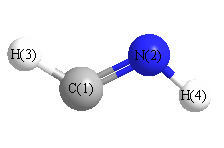 More geometry information
Calculated Bond Angles
| atom1 |
atom2 |
atom3 |
angle |
|
atom1 |
atom2 |
atom3 |
angle |
| C1 |
N2 |
H4 |
129.887 |
|
H3 |
C1 |
N2 |
135.353 |
Electronic energy levels
Charges, Dipole, Quadrupole and Polarizability
Charges from optimized geometry at LSDA/3-21G*
Charges (e)
| Number |
Element |
Mulliken |
CHELPG |
AIM |
ESP |
| 1 |
C |
0.010 |
|
|
|
| 2 |
N |
-0.501 |
|
|
|
| 3 |
H |
0.198 |
|
|
|
| 4 |
H |
0.294 |
|
|
|
Electric dipole moments
Electric dipole components in Debye
(What's a Debye? See section
VII.A.3)
| |
x |
y |
z |
Total |
| |
-2.365 |
-0.216 |
0.000 |
2.375 |
| CHELPG |
|
|
|
|
| AIM |
|
|
|
|
| ESP |
|
|
|
|
Electric Quadrupole moment
Quadrupole components in D Å
| Primitive |
|---|
| | x | y | z |
|---|
| x |
-12.233 |
0.509 |
0.000 |
| y |
0.509 |
-10.588 |
0.000 |
| z |
0.000 |
0.000 |
-12.378 |
|
| Traceless |
|---|
| | x | y | z |
|---|
| x |
-0.750 |
0.509 |
0.000 |
| y |
0.509 |
1.717 |
0.000 |
| z |
0.000 |
0.000 |
-0.967 |
|
| Polar |
|---|
| 3z2-r2 | -1.934 |
|---|
| x2-y2 | -1.644 |
|---|
| xy | 0.509 |
|---|
| xz | 0.000 |
|---|
| yz | 0.000 |
|---|
|
Polarizabilities
Components of the polarizability tensor.
Units are
Å
3 (Angstrom cubed)
Change units.
| |
x |
y |
z |
| x |
1.599 |
0.105 |
0.000 |
| y |
0.105 |
3.863 |
0.000 |
| z |
0.000 |
0.000 |
0.969 |
<r2> (average value of r
2) Å
2
| <r2> |
16.885 |
| (<r2>)1/2 |
4.109 |
Jump to
S1C1
Energy calculated at LSDA/3-21G*
| | hartrees |
|---|
| Energy at 0K | -92.911976 |
| Energy at 298.15K | -92.913312 |
| HF Energy | -92.911976 |
| Nuclear repulsion energy | 27.899450 |
The energy at 298.15K was derived from the energy at 0K
and an integrated heat capacity that used the calculated vibrational frequencies.
Vibrational Frequencies calculated at LSDA/3-21G*
| Mode Number |
Symmetry |
Frequency
(cm-1) |
Scaled Frequency
(cm-1) |
IR Intensities
(km mol-1) |
Raman Act
(Å4/u) |
Dep P |
Dep U |
|---|
| 1 |
A' |
3225 |
3167 |
0.62 |
|
|
|
| 2 |
A' |
2927 |
2875 |
30.83 |
|
|
|
| 3 |
A' |
1780 |
1748 |
7.65 |
|
|
|
| 4 |
A' |
1151 |
1130 |
16.42 |
|
|
|
| 5 |
A' |
915 |
899 |
220.50 |
|
|
|
| 6 |
A" |
979 |
962 |
124.90 |
|
|
|
Unscaled Zero Point Vibrational Energy (zpe) 5488.9 cm
-1
Scaled (by 0.982) Zero Point Vibrational Energy (zpe) 5390.1 cm
-1
See section
III.C.1 List or set vibrational scaling factors
to change the scale factors used here.
See section
III.C.2
Calculate a vibrational scaling factor for a given set of molecules
to determine the least squares best scaling factor.
Geometric Data calculated at LSDA/3-21G*
Point Group is Cs
Cartesians (Å)
| Atom |
x (Å) |
y (Å) |
z (Å) |
|---|
| C1 |
-0.003 |
0.657 |
0.000 |
| N2 |
-0.003 |
-0.583 |
0.000 |
| H3 |
0.914 |
1.281 |
0.000 |
| H4 |
-0.881 |
-1.142 |
0.000 |
Atom - Atom Distances (Å)
| |
C1 |
N2 |
H3 |
H4 |
| C1 | | 1.2393 | 1.1094 | 2.0016 |
N2 | 1.2393 | | 2.0770 | 1.0412 | H3 | 1.1094 | 2.0770 | | 3.0156 | H4 | 2.0016 | 1.0412 | 3.0156 | |
More geometry information
Calculated Bond Angles
| atom1 |
atom2 |
atom3 |
angle |
|
atom1 |
atom2 |
atom3 |
angle |
| C1 |
N2 |
H4 |
122.503 |
|
H3 |
C1 |
N2 |
124.250 |
Electronic energy levels
Charges, Dipole, Quadrupole and Polarizability
Charges from optimized geometry at LSDA/3-21G*
Charges (e)
| Number |
Element |
Mulliken |
CHELPG |
AIM |
ESP |
| 1 |
C |
-0.037 |
|
|
|
| 2 |
N |
-0.494 |
|
|
|
| 3 |
H |
0.217 |
|
|
|
| 4 |
H |
0.314 |
|
|
|
Electric dipole moments
Electric dipole components in Debye
(What's a Debye? See section
VII.A.3)
| |
x |
y |
z |
Total |
| |
-0.488 |
-0.293 |
0.000 |
0.569 |
| CHELPG |
|
|
|
|
| AIM |
|
|
|
|
| ESP |
|
|
|
|
Electric Quadrupole moment
Quadrupole components in D Å
| Primitive |
|---|
| | x | y | z |
|---|
| x |
-11.095 |
3.391 |
0.000 |
| y |
3.391 |
-11.246 |
0.000 |
| z |
0.000 |
0.000 |
-12.426 |
|
| Traceless |
|---|
| | x | y | z |
|---|
| x |
0.740 |
3.391 |
0.000 |
| y |
3.391 |
0.515 |
0.000 |
| z |
0.000 |
0.000 |
-1.255 |
|
| Polar |
|---|
| 3z2-r2 | -2.510 |
|---|
| x2-y2 | 0.150 |
|---|
| xy | 3.391 |
|---|
| xz | 0.000 |
|---|
| yz | 0.000 |
|---|
|
Polarizabilities
Components of the polarizability tensor.
Units are
Å
3 (Angstrom cubed)
Change units.
| |
x |
y |
z |
| x |
1.943 |
0.652 |
0.000 |
| y |
0.652 |
3.404 |
0.000 |
| z |
0.000 |
0.000 |
0.984 |
<r2> (average value of r
2) Å
2
| <r2> |
16.759 |
| (<r2>)1/2 |
4.094 |
