Jump to
S1C2
Energy calculated at wB97X-D/3-21G*
| | hartrees |
|---|
| Energy at 0K | -93.396967 |
| Energy at 298.15K | -93.398272 |
| HF Energy | -93.396967 |
| Nuclear repulsion energy | 28.127335 |
The energy at 298.15K was derived from the energy at 0K
and an integrated heat capacity that used the calculated vibrational frequencies.
Vibrational Frequencies calculated at wB97X-D/3-21G*
| Mode Number |
Symmetry |
Frequency
(cm-1) |
Scaled Frequency
(cm-1) |
IR Intensities
(km mol-1) |
Raman Act
(Å4/u) |
Dep P |
Dep U |
|---|
| 1 |
A' |
3307 |
3134 |
0.78 |
|
|
|
| 2 |
A' |
3012 |
2855 |
44.68 |
|
|
|
| 3 |
A' |
1887 |
1788 |
19.32 |
|
|
|
| 4 |
A' |
991 |
939 |
87.10 |
|
|
|
| 5 |
A' |
893 |
846 |
233.25 |
|
|
|
| 6 |
A" |
962 |
912 |
10.90 |
|
|
|
Unscaled Zero Point Vibrational Energy (zpe) 5526.0 cm
-1
Scaled (by 0.9478) Zero Point Vibrational Energy (zpe) 5237.5 cm
-1
See section
III.C.1 List or set vibrational scaling factors
to change the scale factors used here.
See section
III.C.2
Calculate a vibrational scaling factor for a given set of molecules
to determine the least squares best scaling factor.
Geometric Data calculated at wB97X-D/3-21G*
Point Group is Cs
Cartesians (Å)
| Atom |
x (Å) |
y (Å) |
z (Å) |
|---|
| C1 |
0.107 |
0.645 |
0.000 |
| N2 |
0.107 |
-0.585 |
0.000 |
| H3 |
-0.667 |
1.424 |
0.000 |
| H4 |
-0.725 |
-1.199 |
0.000 |
Atom - Atom Distances (Å)
| |
C1 |
N2 |
H3 |
H4 |
| C1 | | 1.2297 | 1.0987 | 2.0230 |
N2 | 1.2297 | | 2.1531 | 1.0344 | H3 | 1.0987 | 2.1531 | | 2.6237 | H4 | 2.0230 | 1.0344 | 2.6237 | |
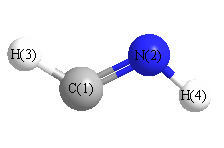 More geometry information
Calculated Bond Angles
| atom1 |
atom2 |
atom3 |
angle |
|
atom1 |
atom2 |
atom3 |
angle |
| C1 |
N2 |
H4 |
126.418 |
|
H3 |
C1 |
N2 |
135.181 |
Electronic energy levels
Charges, Dipole, Quadrupole and Polarizability
Charges from optimized geometry at wB97X-D/3-21G*
Charges (e)
| Number |
Element |
Mulliken |
CHELPG |
AIM |
ESP |
| 1 |
C |
0.037 |
|
|
|
| 2 |
N |
-0.557 |
|
|
|
| 3 |
H |
0.209 |
|
|
|
| 4 |
H |
0.311 |
|
|
|
Electric dipole moments
Electric dipole components in Debye
(What's a Debye? See section
VII.A.3)
| |
x |
y |
z |
Total |
| |
-2.484 |
0.027 |
0.000 |
2.484 |
| CHELPG |
|
|
|
|
| AIM |
|
|
|
|
| ESP |
|
|
|
|
Electric Quadrupole moment
Quadrupole components in D Å
| Primitive |
|---|
| | x | y | z |
|---|
| x |
-12.105 |
0.673 |
0.000 |
| y |
0.673 |
-10.569 |
0.000 |
| z |
0.000 |
0.000 |
-12.349 |
|
| Traceless |
|---|
| | x | y | z |
|---|
| x |
-0.646 |
0.673 |
0.000 |
| y |
0.673 |
1.658 |
0.000 |
| z |
0.000 |
0.000 |
-1.012 |
|
| Polar |
|---|
| 3z2-r2 | -2.024 |
|---|
| x2-y2 | -1.536 |
|---|
| xy | 0.673 |
|---|
| xz | 0.000 |
|---|
| yz | 0.000 |
|---|
|
Polarizabilities
Components of the polarizability tensor.
Units are
Å
3 (Angstrom cubed)
Change units.
| |
x |
y |
z |
| x |
1.491 |
0.052 |
0.000 |
| y |
0.052 |
3.640 |
0.000 |
| z |
0.000 |
0.000 |
0.941 |
<r2> (average value of r
2) Å
2
| <r2> |
16.734 |
| (<r2>)1/2 |
4.091 |
Jump to
S1C1
Energy calculated at wB97X-D/3-21G*
| | hartrees |
|---|
| Energy at 0K | -93.404187 |
| Energy at 298.15K | -93.405540 |
| HF Energy | -93.404187 |
| Nuclear repulsion energy | 28.012736 |
The energy at 298.15K was derived from the energy at 0K
and an integrated heat capacity that used the calculated vibrational frequencies.
Vibrational Frequencies calculated at wB97X-D/3-21G*
| Mode Number |
Symmetry |
Frequency
(cm-1) |
Scaled Frequency
(cm-1) |
IR Intensities
(km mol-1) |
Raman Act
(Å4/u) |
Dep P |
Dep U |
|---|
| 1 |
A' |
3421 |
3243 |
4.55 |
|
|
|
| 2 |
A' |
3053 |
2894 |
25.31 |
|
|
|
| 3 |
A' |
1803 |
1709 |
15.50 |
|
|
|
| 4 |
A' |
1206 |
1143 |
17.13 |
|
|
|
| 5 |
A' |
935 |
886 |
258.22 |
|
|
|
| 6 |
A" |
1015 |
962 |
142.70 |
|
|
|
Unscaled Zero Point Vibrational Energy (zpe) 5716.8 cm
-1
Scaled (by 0.9478) Zero Point Vibrational Energy (zpe) 5418.4 cm
-1
See section
III.C.1 List or set vibrational scaling factors
to change the scale factors used here.
See section
III.C.2
Calculate a vibrational scaling factor for a given set of molecules
to determine the least squares best scaling factor.
Geometric Data calculated at wB97X-D/3-21G*
Point Group is Cs
Cartesians (Å)
| Atom |
x (Å) |
y (Å) |
z (Å) |
|---|
| C1 |
-0.001 |
0.656 |
0.000 |
| N2 |
-0.001 |
-0.585 |
0.000 |
| H3 |
0.892 |
1.291 |
0.000 |
| H4 |
-0.873 |
-1.131 |
0.000 |
Atom - Atom Distances (Å)
| |
C1 |
N2 |
H3 |
H4 |
| C1 | | 1.2410 | 1.0962 | 1.9886 |
N2 | 1.2410 | | 2.0779 | 1.0287 | H3 | 1.0962 | 2.0779 | | 2.9973 | H4 | 1.9886 | 1.0287 | 2.9973 | |
More geometry information
Calculated Bond Angles
| atom1 |
atom2 |
atom3 |
angle |
|
atom1 |
atom2 |
atom3 |
angle |
| C1 |
N2 |
H4 |
122.082 |
|
H3 |
C1 |
N2 |
125.396 |
Electronic energy levels
Charges, Dipole, Quadrupole and Polarizability
Charges from optimized geometry at wB97X-D/3-21G*
Charges (e)
| Number |
Element |
Mulliken |
CHELPG |
AIM |
ESP |
| 1 |
C |
-0.004 |
|
|
|
| 2 |
N |
-0.546 |
|
|
|
| 3 |
H |
0.227 |
|
|
|
| 4 |
H |
0.324 |
|
|
|
Electric dipole moments
Electric dipole components in Debye
(What's a Debye? See section
VII.A.3)
| |
x |
y |
z |
Total |
| |
-0.554 |
-0.038 |
0.000 |
0.555 |
| CHELPG |
|
|
|
|
| AIM |
|
|
|
|
| ESP |
|
|
|
|
Electric Quadrupole moment
Quadrupole components in D Å
| Primitive |
|---|
| | x | y | z |
|---|
| x |
-11.064 |
3.421 |
0.000 |
| y |
3.421 |
-11.142 |
0.000 |
| z |
0.000 |
0.000 |
-12.398 |
|
| Traceless |
|---|
| | x | y | z |
|---|
| x |
0.706 |
3.421 |
0.000 |
| y |
3.421 |
0.589 |
0.000 |
| z |
0.000 |
0.000 |
-1.295 |
|
| Polar |
|---|
| 3z2-r2 | -2.591 |
|---|
| x2-y2 | 0.078 |
|---|
| xy | 3.421 |
|---|
| xz | 0.000 |
|---|
| yz | 0.000 |
|---|
|
Polarizabilities
Components of the polarizability tensor.
Units are
Å
3 (Angstrom cubed)
Change units.
| |
x |
y |
z |
| x |
1.867 |
0.503 |
0.000 |
| y |
0.503 |
3.396 |
0.000 |
| z |
0.000 |
0.000 |
0.978 |
<r2> (average value of r
2) Å
2
| <r2> |
16.649 |
| (<r2>)1/2 |
4.080 |
