Jump to
S1C2
Energy calculated at QCISD/3-21G*
| | hartrees |
|---|
| Energy at 0K | -1066.292371 |
| Energy at 298.15K | -1066.294810 |
| HF Energy | -1065.678328 |
| Nuclear repulsion energy | 259.564503 |
The energy at 298.15K was derived from the energy at 0K
and an integrated heat capacity that used the calculated vibrational frequencies.
Vibrational Frequencies calculated at QCISD/3-21G*
| Mode Number |
Symmetry |
Frequency
(cm-1) |
Scaled Frequency
(cm-1) |
IR Intensities
(km mol-1) |
Raman Act
(Å4/u) |
Dep P |
Dep U |
|---|
| 1 |
A' |
3170 |
3047 |
0.24 |
|
|
|
| 2 |
A' |
2999 |
2883 |
41.65 |
|
|
|
| 3 |
A' |
1682 |
1616 |
62.00 |
|
|
|
| 4 |
A' |
1440 |
1384 |
1.81 |
|
|
|
| 5 |
A' |
1249 |
1200 |
7.00 |
|
|
|
| 6 |
A' |
997 |
958 |
31.79 |
|
|
|
| 7 |
A' |
769 |
739 |
17.48 |
|
|
|
| 8 |
A' |
422 |
405 |
3.47 |
|
|
|
| 9 |
A' |
318 |
306 |
22.67 |
|
|
|
| 10 |
A' |
259 |
249 |
1.31 |
|
|
|
| 11 |
A" |
1285 |
1235 |
19.73 |
|
|
|
| 12 |
A" |
1025 |
985 |
20.62 |
|
|
|
| 13 |
A" |
707 |
680 |
88.44 |
|
|
|
| 14 |
A" |
286 |
275 |
1.92 |
|
|
|
| 15 |
A" |
78 |
75 |
8.08 |
|
|
|
Unscaled Zero Point Vibrational Energy (zpe) 8342.9 cm
-1
Scaled (by 0.9611) Zero Point Vibrational Energy (zpe) 8018.3 cm
-1
See section
III.C.1 List or set vibrational scaling factors
to change the scale factors used here.
See section
III.C.2
Calculate a vibrational scaling factor for a given set of molecules
to determine the least squares best scaling factor.
Geometric Data calculated at QCISD/3-21G*
Point Group is Cs
Cartesians (Å)
| Atom |
x (Å) |
y (Å) |
z (Å) |
|---|
| C1 |
0.399 |
-0.016 |
0.000 |
| C2 |
-0.174 |
1.418 |
0.000 |
| H3 |
1.488 |
0.010 |
0.000 |
| Cl4 |
-0.174 |
-0.861 |
1.486 |
| Cl5 |
-0.174 |
-0.861 |
-1.486 |
| O6 |
0.543 |
2.426 |
0.000 |
| H7 |
-1.275 |
1.437 |
0.000 |
Atom - Atom Distances (Å)
| |
C1 |
C2 |
H3 |
Cl4 |
Cl5 |
O6 |
H7 |
| C1 | | 1.5432 | 1.0897 | 1.8029 | 1.8029 | 2.4460 | 2.2164 |
C2 | 1.5432 | | 2.1779 | 2.7203 | 2.7203 | 1.2371 | 1.1019 | H3 | 1.0897 | 2.1779 | | 2.3932 | 2.3932 | 2.5948 | 3.1102 | Cl4 | 1.8029 | 2.7203 | 2.3932 | | 2.9722 | 3.6778 | 2.9500 | Cl5 | 1.8029 | 2.7203 | 2.3932 | 2.9722 | | 3.6778 | 2.9500 | O6 | 2.4460 | 1.2371 | 2.5948 | 3.6778 | 3.6778 | | 2.0698 | H7 | 2.2164 | 1.1019 | 3.1102 | 2.9500 | 2.9500 | 2.0698 | |
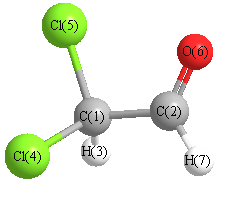 More geometry information
Calculated Bond Angles
| atom1 |
atom2 |
atom3 |
angle |
|
atom1 |
atom2 |
atom3 |
angle |
| C1 |
C2 |
O6 |
122.846 |
|
C1 |
C2 |
H7 |
112.776 |
| C2 |
C1 |
H3 |
110.438 |
|
C2 |
C1 |
Cl4 |
108.525 |
| C2 |
C1 |
Cl5 |
108.525 |
|
H3 |
C1 |
Cl4 |
109.158 |
| H3 |
C1 |
Cl5 |
109.158 |
|
Cl4 |
C1 |
Cl5 |
111.033 |
| O6 |
C2 |
H7 |
124.378 |
|
Electronic energy levels
Charges, Dipole, Quadrupole and Polarizability
Jump to
S1C1
Energy calculated at QCISD/3-21G*
| | hartrees |
|---|
| Energy at 0K | -1066.292380 |
| Energy at 298.15K | |
| HF Energy | -1065.677558 |
| Nuclear repulsion energy | 262.812699 |
The energy at 298.15K was derived from the energy at 0K
and an integrated heat capacity that used the calculated vibrational frequencies.
Vibrational Frequencies calculated at QCISD/3-21G*
| Mode Number |
Symmetry |
Frequency
(cm-1) |
Scaled Frequency
(cm-1) |
IR Intensities
(km mol-1) |
Raman Act
(Å4/u) |
Dep P |
Dep U |
|---|
| 1 |
A |
3127 |
3006 |
2.16 |
|
|
|
| 2 |
A |
2986 |
2869 |
46.93 |
|
|
|
| 3 |
A |
1686 |
1621 |
50.01 |
|
|
|
| 4 |
A |
1434 |
1378 |
8.49 |
|
|
|
| 5 |
A |
1293 |
1243 |
10.32 |
|
|
|
| 6 |
A |
1275 |
1225 |
12.39 |
|
|
|
| 7 |
A |
1019 |
980 |
10.81 |
|
|
|
| 8 |
A |
926 |
890 |
16.88 |
|
|
|
| 9 |
A |
797 |
766 |
53.57 |
|
|
|
| 10 |
A |
634 |
609 |
32.09 |
|
|
|
| 11 |
A |
605 |
582 |
28.90 |
|
|
|
| 12 |
A |
349 |
336 |
1.48 |
|
|
|
| 13 |
A |
274 |
263 |
2.87 |
|
|
|
| 14 |
A |
226 |
217 |
3.05 |
|
|
|
| 15 |
A |
101 |
97 |
9.67 |
|
|
|
Unscaled Zero Point Vibrational Energy (zpe) 8366.6 cm
-1
Scaled (by 0.9611) Zero Point Vibrational Energy (zpe) 8041.1 cm
-1
See section
III.C.1 List or set vibrational scaling factors
to change the scale factors used here.
See section
III.C.2
Calculate a vibrational scaling factor for a given set of molecules
to determine the least squares best scaling factor.
Geometric Data calculated at QCISD/3-21G*
Point Group is C1
Cartesians (Å)
| Atom |
x (Å) |
y (Å) |
z (Å) |
|---|
| C1 |
0.111 |
-0.036 |
0.537 |
| C2 |
-0.733 |
-1.287 |
0.186 |
| H3 |
0.237 |
0.046 |
1.620 |
| Cl4 |
1.762 |
-0.273 |
-0.172 |
| Cl5 |
-0.668 |
1.454 |
-0.058 |
| O6 |
-1.862 |
-1.247 |
-0.312 |
| H7 |
-0.208 |
-2.222 |
0.443 |
Atom - Atom Distances (Å)
| |
C1 |
C2 |
H3 |
Cl4 |
Cl5 |
O6 |
H7 |
| C1 | | 1.5493 | 1.0931 | 1.8120 | 1.7843 | 2.4663 | 2.2114 |
C2 | 1.5493 | | 2.1844 | 2.7172 | 2.7527 | 1.2345 | 1.1029 | H3 | 1.0931 | 2.1844 | | 2.3738 | 2.3709 | 3.1322 | 2.5934 | Cl4 | 1.8120 | 2.7172 | 2.3738 | | 2.9838 | 3.7557 | 2.8394 | Cl5 | 1.7843 | 2.7527 | 2.3709 | 2.9838 | | 2.9647 | 3.7390 | O6 | 2.4663 | 1.2345 | 3.1322 | 3.7557 | 2.9647 | | 2.0626 | H7 | 2.2114 | 1.1029 | 2.5934 | 2.8394 | 3.7390 | 2.0626 | |
More geometry information
Calculated Bond Angles
| atom1 |
atom2 |
atom3 |
angle |
|
atom1 |
atom2 |
atom3 |
angle |
| C1 |
C2 |
O6 |
124.346 |
|
C1 |
C2 |
H7 |
111.880 |
| C2 |
C1 |
H3 |
110.319 |
|
C2 |
C1 |
Cl4 |
107.623 |
| C2 |
C1 |
Cl5 |
111.134 |
|
H3 |
C1 |
Cl4 |
106.978 |
| H3 |
C1 |
Cl5 |
108.572 |
|
Cl4 |
C1 |
Cl5 |
112.136 |
| O6 |
C2 |
H7 |
123.772 |
|
Electronic energy levels
Charges, Dipole, Quadrupole and Polarizability
