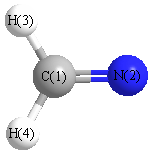
Vibrational Frequencies calculated at LSDA/3-21G*
| Mode Number |
Symmetry |
Frequency
(cm-1) |
Scaled Frequency
(cm-1) |
IR Intensities
(km mol-1) |
Raman Act
(Å4/u) |
Dep P |
Dep U |
|---|
| 1 |
A1 |
2871 |
2819 |
1.17 |
|
|
|
| 2 |
A1 |
1661 |
1631 |
3.48 |
|
|
|
| 3 |
A1 |
1362 |
1337 |
19.29 |
|
|
|
| 4 |
B1 |
972 |
954 |
60.93 |
|
|
|
| 5 |
B2 |
2898 |
2846 |
14.00 |
|
|
|
| 6 |
B2 |
897 |
881 |
0.35 |
|
|
|
Unscaled Zero Point Vibrational Energy (zpe) 5330.1 cm
-1
Scaled (by 0.982) Zero Point Vibrational Energy (zpe) 5234.1 cm
-1
See section
III.C.1 List or set vibrational scaling factors
to change the scale factors used here.
See section
III.C.2
Calculate a vibrational scaling factor for a given set of molecules
to determine the least squares best scaling factor.
Charges, Dipole, Quadrupole and Polarizability
Charges from optimized geometry at LSDA/3-21G*
Charges (e)
| Number |
Element |
Mulliken |
CHELPG |
AIM |
ESP |
| 1 |
C |
-0.251 |
|
|
|
| 2 |
N |
-0.237 |
|
|
|
| 3 |
H |
0.244 |
|
|
|
| 4 |
H |
0.244 |
|
|
|
Electric dipole moments
Electric dipole components in Debye
(What's a Debye? See section
VII.A.3)
| |
x |
y |
z |
Total |
| |
0.000 |
0.000 |
-2.347 |
2.347 |
| CHELPG |
|
|
|
|
| AIM |
|
|
|
|
| ESP |
|
|
|
|
Electric Quadrupole moment
Quadrupole components in D Å
| Primitive |
|---|
| | x | y | z |
|---|
| x |
-12.604 |
0.000 |
0.000 |
| y |
0.000 |
-10.829 |
0.000 |
| z |
0.000 |
0.000 |
-12.581 |
|
| Traceless |
|---|
| | x | y | z |
|---|
| x |
-0.899 |
0.000 |
0.000 |
| y |
0.000 |
1.763 |
0.000 |
| z |
0.000 |
0.000 |
-0.864 |
|
| Polar |
|---|
| 3z2-r2 | -1.728 |
|---|
| x2-y2 | -1.775 |
|---|
| xy | 0.000 |
|---|
| xz | 0.000 |
|---|
| yz | 0.000 |
|---|
|
Polarizabilities
Components of the polarizability tensor.
Units are
Å
3 (Angstrom cubed)
Change units.
| |
x |
y |
z |
| x |
0.921 |
0.000 |
0.000 |
| y |
0.000 |
2.018 |
0.000 |
| z |
0.000 |
0.000 |
3.027 |
<r2> (average value of r
2) Å
2
| <r2> |
17.132 |
| (<r2>)1/2 |
4.139 |