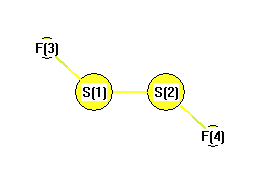
Vibrational Frequencies calculated at HF/6-31G
| Mode Number |
Symmetry |
Frequency
(cm-1) |
Scaled Frequency
(cm-1) |
IR Intensities
(km mol-1) |
Raman Act
(Å4/u) |
Dep P |
Dep U |
|---|
| 1 |
A |
826 |
746 |
37.28 |
|
|
|
| 2 |
A |
482 |
435 |
0.73 |
|
|
|
| 3 |
A |
228 |
206 |
0.01 |
|
|
|
| 4 |
A |
129 |
117 |
6.21 |
|
|
|
| 5 |
B |
816 |
736 |
73.86 |
|
|
|
| 6 |
B |
275 |
249 |
14.03 |
|
|
|
Unscaled Zero Point Vibrational Energy (zpe) 1378.1 cm
-1
Scaled (by 0.9029) Zero Point Vibrational Energy (zpe) 1244.3 cm
-1
See section
III.C.1 List or set vibrational scaling factors
to change the scale factors used here.
See section
III.C.2
Calculate a vibrational scaling factor for a given set of molecules
to determine the least squares best scaling factor.
Charges, Dipole, Quadrupole and Polarizability
Charges from optimized geometry at HF/6-31G
Charges (e)
| Number |
Element |
Mulliken |
CHELPG |
AIM |
ESP |
| 1 |
S |
0.472 |
|
|
|
| 2 |
S |
0.472 |
|
|
|
| 3 |
F |
-0.472 |
|
|
|
| 4 |
F |
-0.472 |
|
|
|
Electric dipole moments
Electric dipole components in Debye
(What's a Debye? See section
VII.A.3)
| |
x |
y |
z |
Total |
| |
0.000 |
0.000 |
-2.779 |
2.779 |
| CHELPG |
|
|
|
|
| AIM |
|
|
|
|
| ESP |
|
|
|
|
Electric Quadrupole moment
Quadrupole components in D Å
| Primitive |
|---|
| | x | y | z |
|---|
| x |
-35.707 |
-3.350 |
0.000 |
| y |
-3.350 |
-40.122 |
0.000 |
| z |
0.000 |
0.000 |
-36.667 |
|
| Traceless |
|---|
| | x | y | z |
|---|
| x |
2.688 |
-3.350 |
0.000 |
| y |
-3.350 |
-3.935 |
0.000 |
| z |
0.000 |
0.000 |
1.247 |
|
| Polar |
|---|
| 3z2-r2 | 2.494 |
|---|
| x2-y2 | 4.415 |
|---|
| xy | -3.350 |
|---|
| xz | 0.000 |
|---|
| yz | 0.000 |
|---|
|
Polarizabilities
Components of the polarizability tensor.
Units are
Å
3 (Angstrom cubed)
Change units.
| |
x |
y |
z |
| x |
3.667 |
-0.969 |
0.000 |
| y |
-0.969 |
7.871 |
0.000 |
| z |
0.000 |
0.000 |
3.513 |
<r2> (average value of r
2) Å
2
| <r2> |
135.936 |
| (<r2>)1/2 |
11.659 |