Jump to
S2C1
Energy calculated at MP2/6-31G
| | hartrees |
|---|
| Energy at 0K | -497.863727 |
| Energy at 298.15K | -497.863528 |
| HF Energy | -497.749012 |
| Nuclear repulsion energy | 36.005491 |
The energy at 298.15K was derived from the energy at 0K
and an integrated heat capacity that used the calculated vibrational frequencies.
Geometric Data calculated at MP2/6-31G
Point Group is Cs
Cartesians (Å)
| Atom |
x (Å) |
y (Å) |
z (Å) |
|---|
| C1 |
0.046 |
1.295 |
0.000 |
| Cl2 |
0.046 |
-0.546 |
0.000 |
| H3 |
-1.055 |
1.512 |
0.000 |
Atom - Atom Distances (Å)
| |
C1 |
Cl2 |
H3 |
| C1 | | 1.8408 | 1.1223 |
Cl2 | 1.8408 | | 2.3336 | H3 | 1.1223 | 2.3336 | |
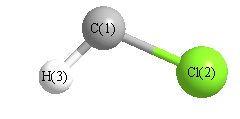 More geometry information
Calculated Bond Angles
| atom1 |
atom2 |
atom3 |
angle |
|
atom1 |
atom2 |
atom3 |
angle |
| Cl2 |
C1 |
H3 |
101.131 |
|
Electronic energy levels
Charges, Dipole, Quadrupole and Polarizability
Jump to
S1C1
Energy calculated at MP2/6-31G
| | hartrees |
|---|
| Energy at 0K | -497.879259 |
| Energy at 298.15K | -497.879080 |
| HF Energy | -497.785527 |
| Nuclear repulsion energy | 36.788423 |
The energy at 298.15K was derived from the energy at 0K
and an integrated heat capacity that used the calculated vibrational frequencies.
Geometric Data calculated at MP2/6-31G
Point Group is Cs
Cartesians (Å)
| Atom |
x (Å) |
y (Å) |
z (Å) |
|---|
| C1 |
0.037 |
1.234 |
0.000 |
| Cl2 |
0.037 |
-0.544 |
0.000 |
| H3 |
-0.859 |
1.848 |
0.000 |
Atom - Atom Distances (Å)
| |
C1 |
Cl2 |
H3 |
| C1 | | 1.7789 | 1.0859 |
Cl2 | 1.7789 | | 2.5544 | H3 | 1.0859 | 2.5544 | |
More geometry information
Calculated Bond Angles
| atom1 |
atom2 |
atom3 |
angle |
|
atom1 |
atom2 |
atom3 |
angle |
| Cl2 |
C1 |
H3 |
124.378 |
|
Electronic energy levels
Charges, Dipole, Quadrupole and Polarizability
