return to home page Computational Chemistry Comparison and Benchmark DataBase Release 22 (May 2022) Standard Reference Database 101 National Institute of Standards and Technology
You are here: Experimental > One molecule all properties

Experimental data for CHCl2+ (dichloromethyl cation)

22 02 02 11 45
INChI INChIKey SMILES IUPAC name
InChI=1S/CHCl2/c2-1-3/h1H/q+1 Cl[CH+]Cl
State Conformation
1A1 C2V
Enthalpy of formation (Hfg), Entropy, Integrated heat capacity (0 K to 298.15 K) (HH), Heat Capacity (Cp)
Property Value Uncertainty units Reference Comment
Hfg(298.15K) enthalpy of formation 888.50 1.50 kJ mol-1 2008Shu/Zha:10533-10538
Hfg(0K) enthalpy of formation 891.70 1.50 kJ mol-1 2008Shu/Zha:10533-10538
Integrated Heat Capacity (0 to 298.15K) integrated heat capacity 11.20   kJ mol-1 2008Shu/Zha:10533-10538
Information can also be found for this species in the NIST Chemistry Webbook
Vibrational levels (cm-1) vibrations
Mode Number Symmetry Frequency Intensity Comment Description
Fundamental(cm-1) Harmonic(cm-1) Reference (km mol-1) unc. Reference
1 A1 3033   webbook       CH stretch
2 A1 860           CCl2 s-str
5 B2 1291           CH bend
6 B2 1044           CCl2 a-str

Calculated vibrational frequencies for CHCl2+ (dichloromethyl cation).
Rotational Constants (cm-1) rotational constants
See section I.F.4 to change rotational constant units
A B C reference comment

Calculated rotational constants for CHCl2+ (dichloromethyl cation).
Product of moments of inertia moments of inertia
amu3Å6   0gm3 cm6
Geometric Data
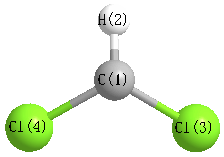
picture of dichloromethyl cation

Point Group C2v


Internal coordinates
distances (r) in Å, angles (a) in degrees, dihedrals (d) in degrees
Description Value unc. Connectivity Reference Comment
Atom 1 Atom 2 Atom 3 Atom 4

Cartesians
Atom x (Å) y (Å) z (Å)

Atom - Atom Distances bond lengths
Distances in Å
 

Calculated geometries for CHCl2+ (dichloromethyl cation).

Bond descriptions


Examples: C-C single bond, C=C, double bond, C#C triple bond, C:C aromatic bond
Bond Type Count
H-C 1
C-Cl 2

Connectivity
Atom 1 Atom 2
C1 H2
C1 Cl3
C1 Cl4
Electronic energy levels (cm-1)
Energy (cm-1) Degeneracy reference description
Dipole, Quadrupole and Polarizability
Electric dipole moment dipole
State Config State description Conf description Exp. min. Dipole (Debye) Reference comment Point Group Components
x y z total dipole quadrupole
1 1 1A1 C2v True           C2v 1 2
Experimental dipole measurement abbreviations: MW microwave; DT Dielectric with Temperature variation; DR Indirect (usually an upper limit); MB Molecular beam
Calculated electric dipole moments for CHCl2+ (dichloromethyl cation).
Electric quadrupole moment quadrupole
State Config State description Conf description Exp. min. Quadrupole (D Å) Reference comment Point Group Components
xx yy zz dipole quadrupole
1 1 1A1 C2v True       C2v 1 2

Calculated electric quadrupole moments for CHCl2+ (dichloromethyl cation).

References
By selecting the following links, you may be leaving NIST webspace. We have provided these links to other web sites because they may have information that would be of interest to you. No inferences should be drawn on account of other sites being referenced, or not, from this page. There may be other web sites that are more appropriate for your purpose. NIST does not necessarily endorse the views expressed, or concur with the facts presented on these sites. Further, NIST does not endorse any commercial products that may be mentioned on these sites. Please address comments about this page to [email protected].
squib reference DOI
2008Shu/Zha:10533-10538 NS Shuman, LY Zhao, M Boles, T Baer, B Sztaray "Heats of Formation of HCCl3, HCCl2Br, HCClBr2, HCBr3, and Their Fragment Ions Studied by Threshold Photoelectron Photoion Coincidence" J. Phys. Chem. A 2008, 112, 10533–10538 10.1021/jp8056459
webbook NIST Chemistry Webbook (http://webbook.nist.gov/chemistry) 10.18434/T4D303

Got a better number? Please email us at [email protected]


Browse
PreviousNext